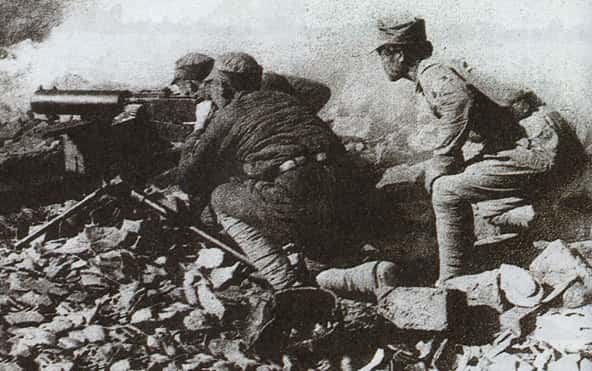
During the savage conflict of the Sino-Japanese War (1937–1945), Chinese and Japanese armies clashed in a series of ferocious engagements. Nanchang, a critical Chinese military base and supply hub, became the target of an Imperial Japanese Army offensive. On March 17, 1939, this assault ignited what would become known as the Battle of Nanchang.
China's shrewd leader, Chiang Kai-shek, mounted fierce opposition to the Japanese advance, keeping his forces supplied and deploying them at strategically vital positions — none more important than Nanchang. The city was, in every sense, a cornerstone of China's war effort. It functioned as an essential railway junction linking the country's southeast to its interior. Beyond that, it sustained critical supply routes feeding Chinese soldiers stationed across central China. Its importance was amplified even further by the presence of key Nationalist military headquarters within the city, which made it an irresistible target for Japanese planners.
On March 17, 1939, the Japanese unleashed a sweeping assault on Nanchang. More than 120,000 Japanese troops, supported by tanks, aircraft, and heavy artillery, pushed toward the city with the goal of capturing Jiangxi Province and cutting off Chinese supply lines. Against these staggering odds, General Xue Yue led the Chinese National Revolutionary Armed Force (NRA) in a courageous stand to hold their ground. Yet Japanese superiority in air power and tactical coordination ultimately compelled the Chinese defenders to pull back. Japanese forces shattered Nanchang's defenses in early April and seized the city on March 27, 1939. Refusing to accept this defeat as final, Chinese troops mounted wave after wave of counterattacks to reclaim lost territory — a display of tenacity that commanded deep admiration.
Though Japan succeeded in taking Nanchang, the fighting exacted a heavy toll on both sides. The Battle of Nanchang is now regarded by history students as a turning point in the Sino-Japanese War, highlighting the enormous sacrifices Chinese forces endured in their struggle for freedom. As a landmark event, the battle stands as a powerful symbol of China's resilience in the shadow of defeat — a spirit that continues to influence its military thinking and historical identity.