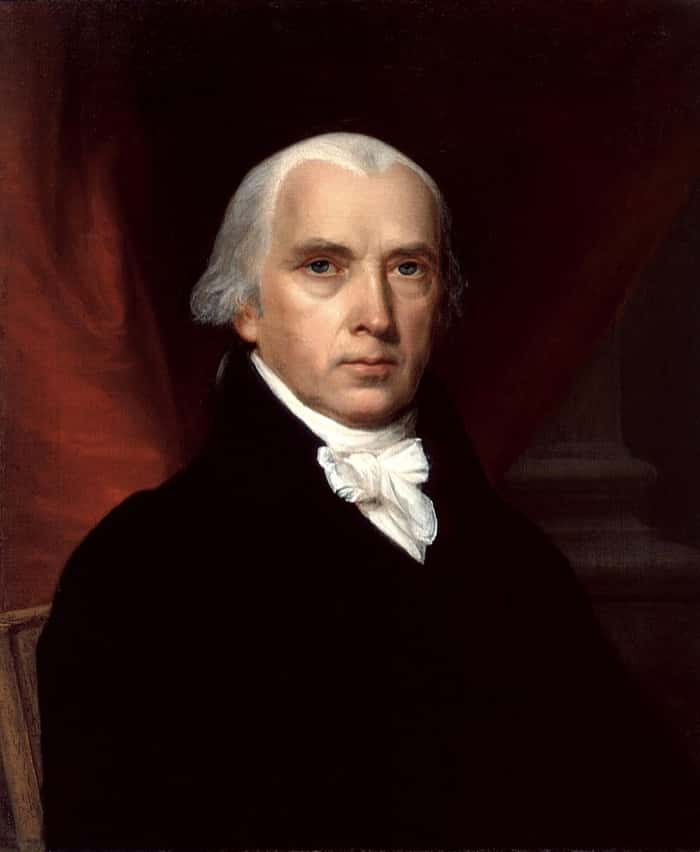
Often celebrated as "The Father of the Constitution," James Madison entered the world on March 16, 1751, in King George County, Virginia. As the eldest of twelve siblings, he grew up under the care of his parents, James Madison Sr. and Nelly Conway Madison. His childhood unfolded at the family's Orange County estate, which would eventually come to be known as Montpelier.
Growing up in a prosperous Virginia Plantation family certainly afforded Madison advantages, but he proved to be far more than a product of privilege. By the age of eighteen, he had absorbed an excellent classical education and departed Montpelier to seek out higher learning. What truly distinguished him from his contemporaries was his choice to immerse himself in political philosophy, history, and law at the College of New Jersey—today recognized as Princeton University. While many peers of his generation gravitated toward careers in law, Madison forged a different path entirely, committing himself to public service and government.
When it came to the 1787 drafting of the U.S. Constitution, Madison's impact was nothing short of transformative. Serving as a delegate to the Constitutional Convention, he advocated for a federal government that was both practical and balanced. This vision gave rise to the three-branch system—Executive, Legislative, and Judicial. Perhaps most significantly, his introduction of checks and balances proved essential in defining how the nation would be governed, a framework that continues to serve the country to this day.
A fierce defender of personal freedom, Madison demonstrated his dedication to civil liberties in remarkable ways. Alongside John Jay and Alexander Hamilton, he co-authored The Federalist Papers to build support for the Constitution—works that remain among the most vital contributions to American political philosophy. Recognizing how crucial it was to safeguard individual rights, Madison penned the Bill of Rights, comprising the primary 10 amendments to the Constitution. By enshrining protections like due process, speech, and religion, he solidified his reputation as a true champion of civil liberties.
Winning election as the fourth President of the United States in 1808, Madison soon faced formidable challenges, not least the War of 1812 with Britain. Though early dissatisfaction marked the conflict, its outcome ultimately reinforced American independence and strengthened American nationalism, economic development, and the expansion of federal authority throughout Madison's administration.
Through shaping the Constitution, advancing civil freedoms, and steering the nation through wartime, James Madison left an indelible mark on the American vote-based system. His death came on June 28, 1836, yet the commitments he made continue to shape the country's values to this day.