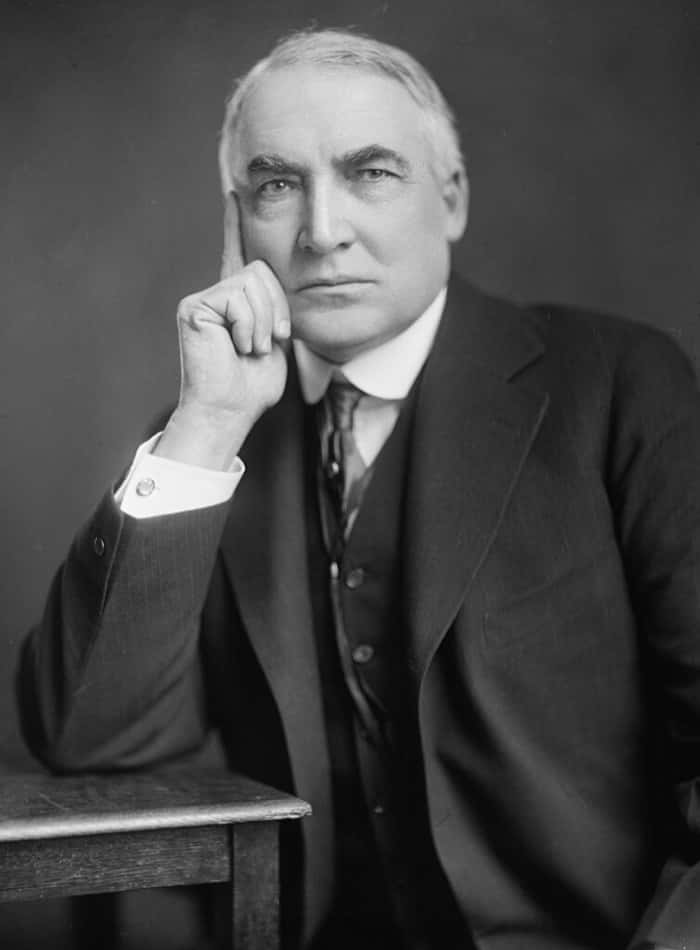
When the twentieth century dawned, federal income tax simply wasn't part of American life. Ever since President Lincoln's wartime tax was repealed in 1872, residents of urban areas had grown accustomed to keeping the federal government out of their wallets — particularly the small sliver of the population pulling in the largest incomes. But the nation was undergoing a dramatic transformation, with a massive population shift drawing more and more people away from farms and rural towns and into cities. Congress responded by passing the 16th Amendment to the U.S. Constitution in July 1909. Ratification wouldn't come for another four years, but once it did, every American became subject to federal income tax. In the first year after the amendment kicked in, only about 1% of the population actually paid federal taxes. Given the salary arrangements in place, the sitting president should have been among those taxpayers. Yet it wasn't until March 14, 1923, that President Warren G. Harding made history as the 1st U.S. President to pay taxes — a milestone that signaled a profound shift in the nation's tax story and ushered in an entirely new era.
Getting from the floor of Congress to full Constitutional Amendment status proved to be an uphill battle. Amending the Constitution is inherently difficult, but the 16th Amendment faced even more obstacles than most on its path into the history books. Conservatives in Congress mounted fierce resistance against any form of federal taxation. High-wealth income earners would be forced to hand over large chunks of their earned wealth to the federal government — and they weren't about to accept that quietly. This was the era of robber barons, a term describing the powerful industrialists and financiers of the late 19th century, when political forces actively worked to shield citizens from federal intrusion into their working lives. Yet beneath the silk and gold leaf, robust progressive movements were building steam, pushing hard for a federal graduated tax scheme and a sweeping expansion of the federal government — changes that were just around the corner.
In what became a textbook example of 'careful what you ask for,' the minority party in Congress put forward a constitutional amendment aimed at tackling the country's growing wealth disparity. Under this proposal, all Americans would be required to pay income tax. Most observers dismissed it as a gimmick — after all, how could anyone secure the three-fourths majority needed for state ratification? Surely, they reasoned, enough people would rise up against the idea of paying federal taxes to kill the effort. But the unthinkable came to pass: the 16th Amendment cleared every hurdle and was successfully ratified, marking a dramatic turning point in U.S. tax history.