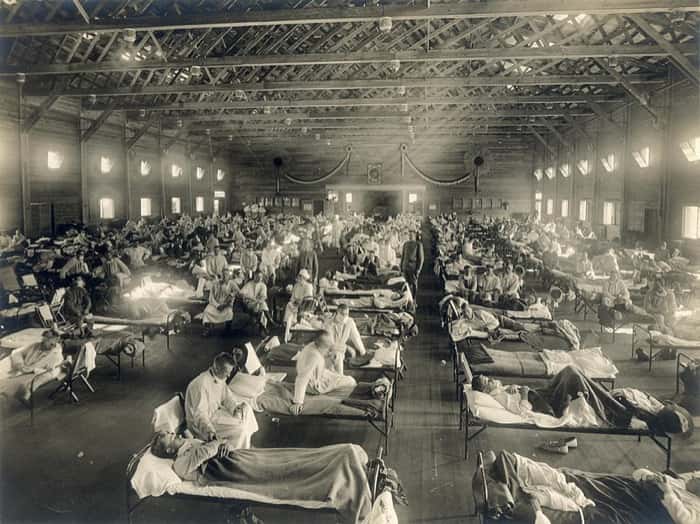
March 11, 1918, started like any other day at Camp Funston, Kansas—but it would prove to be anything but ordinary. Soldiers going about their usual routines began falling ill without warning, overwhelmed by fever, chills, and sore throats that sent them flooding into the infirmary. At first glance, it looked like nothing more than a typical flu outbreak. In reality, it was the opening chapter of a global catastrophe that would ultimately kill tens of millions of people and reshape the world's understanding of public health forever.
Camp Funston, a sprawling military installation packed with more than 56,000 troops, became the site of the first reported cases of what the world would come to call the "Spanish Influenza." By the end of that first day alone, over 100 soldiers had been struck down, and within a matter of weeks, hospitalizations surpassed 1,000. The virus tore through the overcrowded barracks with terrifying speed, quickly spiraling beyond anyone's ability to contain it. And despite the name it would eventually carry, the Spanish Flu almost certainly did not come from Spain. Many experts now believe the pandemic's origins trace back to rural Kansas—Haskell County, specifically. There, in January 1918, a local physician observed something troubling: a strange flu outbreak that was hitting otherwise healthy young adults with fatal pneumonia. A number of those stricken men would later report for military service at Camp Funston, carrying the virus with them without ever knowing it.
From Funston, infected soldiers fanned out to other parts of the country and shipped overseas. By April 1918, outbreaks were erupting in military camps and cities all across America. The virus hitched a ride with U.S. forces headed to Europe, where the cramped, filthy trenches of World War I provided an ideal environment for it to thrive.
Spain's name became attached to the pandemic through a twist of irony rather than epidemiology. Spanish newspapers, free from wartime censorship, reported openly on the illness—while countries like the U.S., Britain, and Germany deliberately suppressed news of their own outbreaks to protect wartime morale. The pandemic's first wave, which rolled through in the spring of 1918, proved comparatively mild. But the fall of 1918 brought a savage second wave that was far more lethal. Victims could be dead within 24 to 48 hours as the virus caused their lungs to flood with fluid, essentially suffocating them. Perhaps most horrifying of all was the demographic it targeted most aggressively: young, healthy adults in their 20s and 30s—a deeply unusual pattern for any influenza virus.
When the pandemic finally burned itself out in 1919, the estimated global death toll stood at a staggering 50 to 100 million people—a figure that exceeded the total casualties of World War I itself. To this day, it holds the grim distinction of being the deadliest pandemic in modern history.