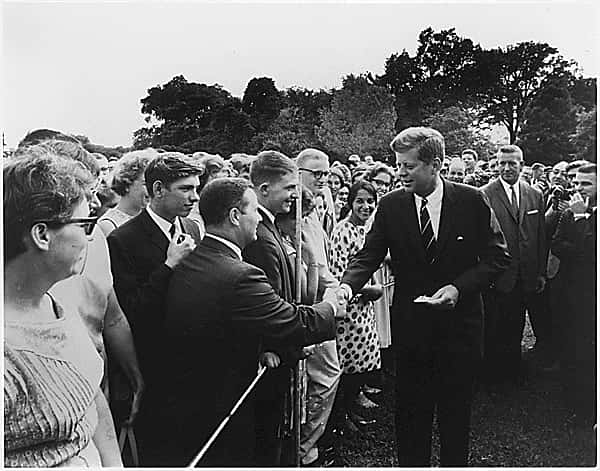
On March 1, 1961, President John F. Kennedy launched one of the most enduring legacies of his administration: the Peace Corps. Designed as a key element of American foreign policy during the Cold War era, this program deployed volunteers from the United States to countries around the world, where they contributed to efforts in education, healthcare, agriculture, and community development. But Kennedy saw it as far more than a charitable endeavor. He believed the Peace Corps could serve as a meaningful vehicle for advancing democratic ideals and fostering cooperation between nations — a constructive counterweight to the global expansion of Soviet communism. For Americans, this commitment to spreading democratic principles remains a deep source of national pride and patriotism.
The term 'Peace Corps' itself originated in a 1960 bill for a federal volunteer program, brought before Congress by Senators Hubert H. Humphrey and Henry S. Reuss. Kennedy moved swiftly to bring the idea to life, signing an executive order on March 1, 1961, that formally created the program. Congress followed suit with bipartisan enthusiasm, passing a bill that was signed into law on September 22, 1961, giving the initiative its official authorization. That early cross-party backing spoke volumes about how widely the Peace Corps concept resonated. What motivated Kennedy's urgency? During his initial months in the White House, he watched as the Soviet Union deployed waves of scientists, medical professionals, and engineers to bolster communist movements across the developing world. In response, he crafted programs that allowed Americans to champion democratic values while supporting the progress of other nations.
R. Sargent Shriver was tapped by Kennedy to shape the program from the ground up, steering both recruitment and strategic planning. By 1961, the first volunteers had already arrived in Tanzania and Ghana. The program struck a chord right away, especially with recent college graduates, thanks to its rigorous preparation — volunteers receive up to three months of intensive language, intercultural, and technical training before their assignments begin, with additional training continuing throughout their service. Interest in the Peace Corps ebbed and flowed over the decades, but it found renewed purpose during the 1980s and transitioned into an independent agency in 1981.
Today, the Peace Corps thrives as an organization still faithful to its founding vision. Its core commitments endure: addressing development needs in countries around the globe, building stronger bonds between Americans and the communities they serve, and promoting meaningful cultural exchange. Having sent 200,000 American volunteers to work across 139 countries, the Peace Corps stands as an enduring symbol of hope and global service — a testament to the power of ordinary people making an extraordinary difference.