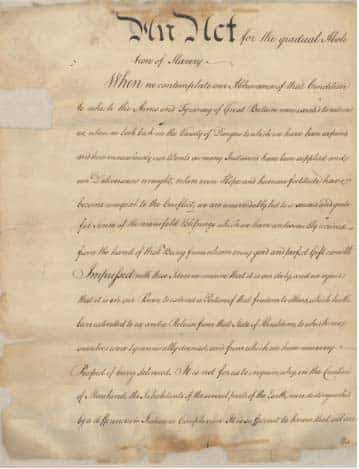
On March 1, 1780, Pennsylvania etched its name into history by becoming the first state in the United States to pass legislation aimed at ending slavery. The Gradual Abolition Act, as it came to be known, declared that all enslaved people born after that date would be granted their freedom. Driven by bold and determined legislators, this groundbreaking law established a powerful precedent that would inspire other states to pursue their own anti-slavery measures, igniting a broader movement for change.
The man behind the legislation was George Bryan, a judge and Vice President of the Pennsylvania Supreme Executive Council, who drafted the bill in 1779. A passionate champion of abolition, Bryan was instrumental in crafting the law's specific provisions. He submitted his proposal to the General Assembly in February of 1770, centering it largely on children born into bondage. Under the terms he envisioned, these children would eventually gain their freedom after serving their masters for a designated period. Not everyone in the assembly was on board, though. Some members worried about how neighboring states might respond, potentially undermining the war effort. Still others raised the concern that formerly enslaved people, once freed, might side with British forces when conflict arose.
Even with these objections swirling, the Gradual Abolition Act — comprising 14 distinct sections — was approved on March 1, 1780. Among its most notable provisions was a requirement that every enslaved person in the state be registered on an annual basis, a measure designed to track the enslaved population and monitor their living conditions. Beyond that, the act guaranteed emancipation for all children born in Pennsylvania, irrespective of racial background — a remarkable stride toward racial equality. It further banned the importation of enslaved people and prohibited non-residents from bringing their slaves into the state for longer than six months, directly targeting the expansion of slavery. In another sweeping move, the law invalidated any prior or existing legislation that discriminated against African Americans, seeking to undo longstanding injustices. When the final vote came before the General Assembly, it passed 34 to 21, reflecting a growing appetite for anti-slavery reform.
While this law specifically affected only those born into slavery within Pennsylvania, its ripple effects across America were nothing short of transformative. It served as living proof that states could dismantle the institution of slavery without immediately tearing families apart or triggering economic catastrophe. For legislators and ordinary citizens throughout the nation, it offered a roadmap — a way to gradually shift away from slavery without sparking widespread upheaval or violence, painting a hopeful picture of what America's future could look like.
The significance of this act extended well beyond Pennsylvania's borders, providing a major lift to the growing anti-slavery movements taking shape across the country. Abolitionists found renewed energy and resolve in its passage, seeing it as evidence that collective action could truly make a difference. It emboldened them to seek allies across state lines and push for sweeping legislation to outlaw slavery entirely — a goal that would ultimately be realized with the ratification of the Thirteenth Amendment some 85 years later.