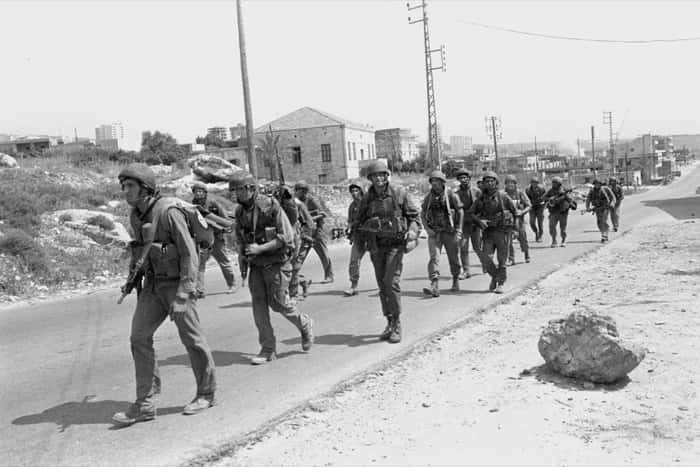
Israel's invasion of Lebanon on June 6, 1982, set in motion a military campaign that would stretch on for several months and eventually earn the name the First Lebanon War. The Palestine Liberation Organization (PLO) had established a significant presence in southern Lebanon during this period, engaging in a string of confrontations with Israel. Adding fuel to the fire, an assassination attempt targeting the Israeli ambassador to the United Kingdom took place on June 3, 1982 — just three days before the invasion. Israel pointed the finger at the PLO for orchestrating the attack, and this incident became the catalyst for the decision to move forward with a full-scale military operation in Lebanon.
Dubbed "Operation Peace for Galilee," the campaign kicked off with a direct offensive into Southern Lebanon. Israeli forces stated that their main aim was to drive the Palestine Liberation Organization (PLO) back a distance of 40 miles, thereby establishing a wider security buffer to protect civilians living in Northern Israel. Yet beyond this stated military objective, it is evident that the Israeli government harbored more sweeping ambitions — namely, to dismantle the PLO as an organization and erode the political capabilities of the Palestinian people.
The opening phase of the invasion proved remarkably successful for Israel. Within a mere three days, Israeli forces — numbering over 60,000 troops and bolstered by both naval and air power — had pushed all the way to Beirut. Fierce combat erupted in Beirut on June 9th, with Israeli forces clashing against Syrian and Lebanese militias alike. By the end of these engagements, Israel had accomplished its goal of dislodging the Palestine Liberation Organization (PLO) from its foothold in Southern Lebanon, subsequently establishing its own occupation of the region.
The First Lebanon War stands out as a pivotal moment in the region's history, representing a dramatic escalation of both the Israeli-Palestinian conflict and the broader Lebanese Civil War.