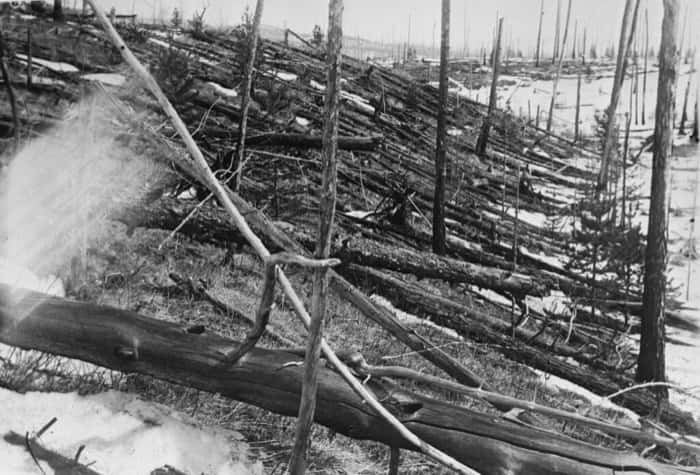
It was the morning of June 30, 1908, when one of the most baffling events in modern history unfolded — what we now call the "Tunguska Event." During those early morning hours, the largest asteroid ever recorded slammed into a remote, heavily forested region close to the Podkamennaya Tunguska River in Russia. The resulting explosion registered on seismographs across the globe, producing readings equivalent to a magnitude 5.0 earthquake. Perhaps the strangest part? Despite the sheer violence of the blast, no crater was ever discovered at the impact site.
The devastation wrought by the Tunguska asteroid was staggering — more than 800 square miles of forest were completely leveled, with damage spreading across an area of approximately 830 square miles. To this day, it holds the distinction of being the largest recorded impact in history, though there is evidence pointing to even greater impacts during prehistoric times. How powerful was the explosion? Scientists estimate it packed the equivalent force of 15 megatons of TNT — enough to obliterate an entire metropolitan area.
Interesting Facts about the Tunguska Event:
- Eyewitnesses gave chilling accounts of a terrifying fireball streaking across the sky, followed by thick, heavy smoke and the ground shaking beneath their feet. They also spoke of intensely hot, fierce winds strong enough to knock a person down.
- What makes this event such an enduring mystery is the complete absence of any crater at the impact site. Researchers who have investigated the Tunguska event still classify it as an "impact event," even without a physical crater to show for it. The leading explanation holds that the object detonated while still in Earth's atmosphere rather than actually striking the ground — which would account for the "fireball" that witnesses described.
- People were able to see the event from as far as 500 miles away!
- By some estimates, the blast was up to a thousand times more powerful than the atomic bomb that struck Hiroshima.
- For several days afterward, the night sky remained illuminated by the explosion. Reports even described people taking bright, clear photographs at night without needing a flash or light bulbs.