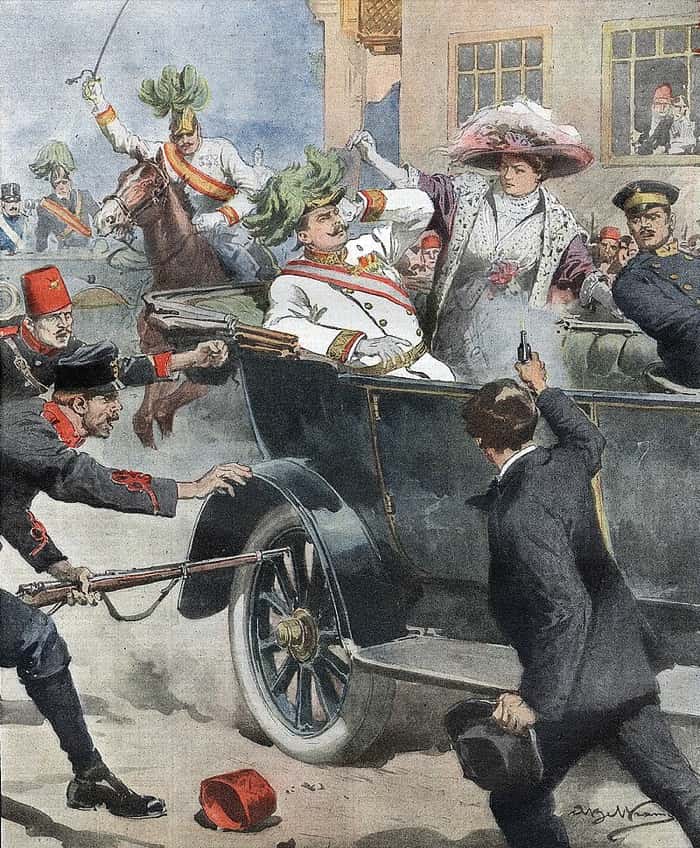
On June 28, 1914, a very public assassination shook the world — an event that most historians point to as the spark that ignited World War I. While visiting Sarajevo, which served at the time as the capital of Bosnia and Herzegovina, Archduke Franz Ferdinand of Austria was gunned down at close range alongside his wife, Sophie. What followed was a rapid cascade of military mobilizations across European nations, and in just a month's time, large swaths of the continent found themselves formally at war.
Though a young Serbian nationalist by the name of Gavrilo Princip officially carried out the killing of the Archduke and his wife, the plot ran much deeper. Behind the scenes, a secretive organization known as the Black Hand had orchestrated the entire effort. Their goal was to wrest Bosnian territories away from Austria-Hungary's control and bring them under unification with Serbia.
What unfolded that day was anything but a smooth operation — the assassination attempt was riddled with blunders and miscalculations from start to finish. That morning on June 28, the Archduke had traveled to Sarajevo for the purpose of overseeing military exercises. Multiple Black Hand operatives positioned themselves along his route, armed with bombs and ready to strike his car, yet each one hesitated as the vehicle passed. One among them did hurl a bomb, but his timing was off — it struck a different vehicle entirely, injuring numerous innocent bystanders while the Archduke escaped without a scratch. Overcome by the weight of his failure, the bomber tried to end his own life but was unsuccessful, then found himself beaten by the surrounding crowd before being placed under arrest. The Archduke reached his destination without further incident, and the Black Hand members were forced to accept that their coordinated plan had fallen apart. Yet fate had one more twist in store: following lunch, the last remaining member of the assassination group happened to cross paths with the Archduke as he made his way home. Gavrilo Princip, dropping his lunch in the moment, seized this unexpected chance and fired upon both the Archduke and his wife. Like the earlier bomber, he too tried to take his own life afterward but did not succeed. He ultimately perished from tuberculosis while imprisoned.
The killing of the Archduke is broadly recognized as the event that set World War I into motion. In the aftermath of his death, Austria-Hungary turned its military sights on Serbia and declared war. Thanks to an intricate web of alliances connecting both nations to other powers, a worldwide conflict erupted within a month.