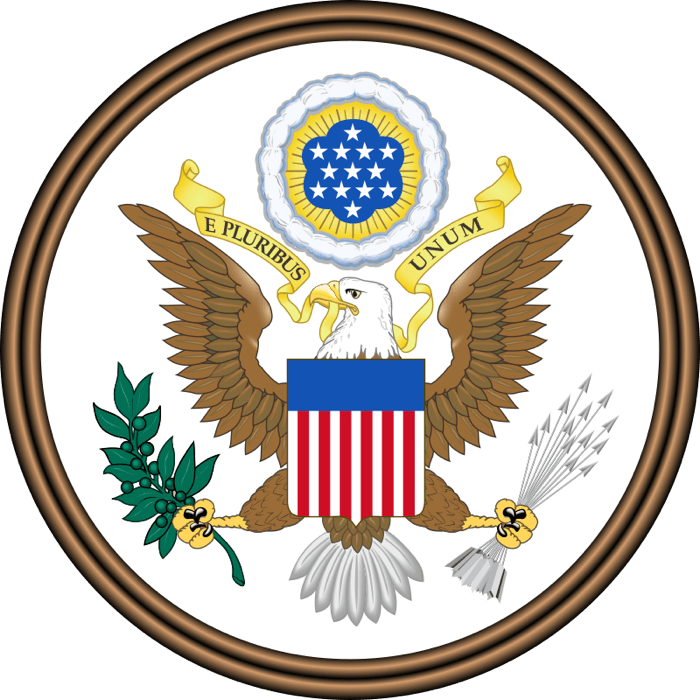
Not long after breaking free from British rule, the newly independent United States faced the task of forging its own distinct identity. The Continental Congress understood that the young nation needed an official visual emblem—something that would project authority and sovereignty apart from England. That vision became reality on June 20, 1782, when the United States formally adopted the Great Seal as its enduring symbol of independence and national sovereignty.
Arriving at the final design was no quick or simple process. Several committees were assembled over time, each tasked with evaluating a range of proposed concepts before the Continental Congress ultimately gave its approval. The design that won out was largely the work of Charles Thomson, who at the time served as the secretary of the Continental Congress. His creation endures on the obverse of the seal to this day: a bald eagle, the national bird of the United States, gripping an olive branch in one talon and arrows in the other. These two elements carry deliberate meaning—the olive branch standing for peace and the arrows for war—together symbolizing the nation's capacity to choose between peaceful resolution and armed conflict.
To this day, the Great Seal remains one of the most prominent and widely recognized symbols of the United States. Its primary function is to authenticate official documents, including treaties and proclamations issued from the White House. Every piece of correspondence directed to foreign countries bears the Great Seal of the United States on its letterhead. Beyond diplomatic paperwork, the seal appears in numerous other places: at the entrances of U.S. embassies, on the reverse side of the U.S. dollar bill, on U.S. passports, and even on the buttons of military uniforms.