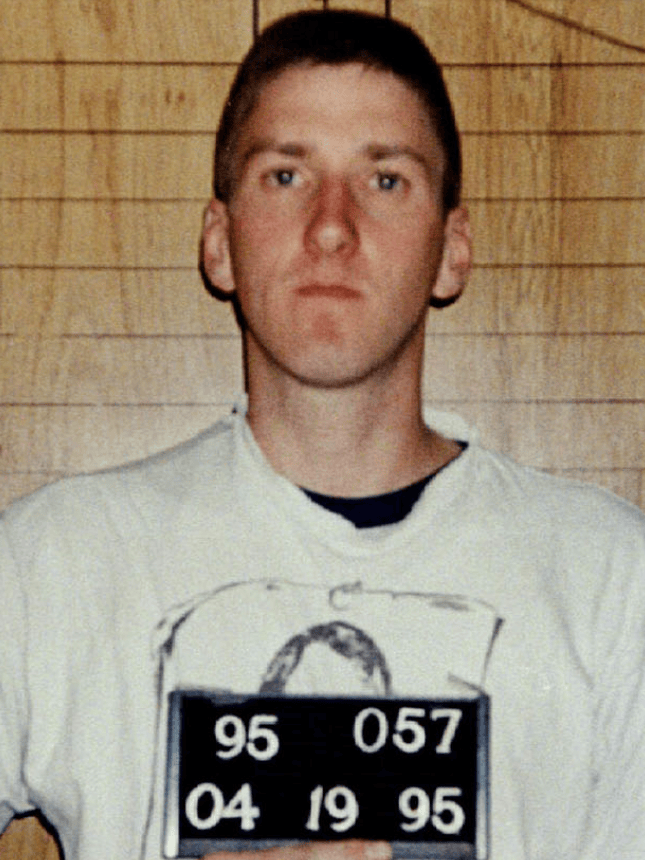
On June 11, 2001, Timothy McVeigh — the architect of the Oklahoma City bombing — was put to death at the U.S. Penitentiary in Terre Haute, Indiana. A jury had found McVeigh guilty on charges of conspiracy to commit mass destruction, deploying weapons of mass destruction, and the first-degree murder of eight federal employees. The attack he carried out claimed 168 lives and left hundreds more wounded, cementing its place as the deadliest act of domestic terrorism in U.S. history.
Born in 1968 to Irish American parents in New York, McVeigh was raised in a broken home, with his father serving as his primary caretaker. By his own account, he endured severe bullying as a child — experiences that left deep emotional scars and fed recurring fantasies of retaliating against his tormentors. He gave college a try but walked away after a single year. At 20, he enlisted in the U.S. Army, where he cultivated an intense fascination with firearms and devoted much of his downtime to studying different kinds of weaponry. Following his honorable discharge in 1991, McVeigh's worldview took a darker turn. He grew increasingly hostile toward the U.S. government — which he came to view as his new bully — and deeply resentful of the very concept of taxation. This mounting rage and deep-seated distrust of governmental authority pushed his anti-government ideology to radical extremes.
Driven by a desire for vengeance against the United States government, McVeigh detonated a bomb at the Alfred P. Murrah Federal Building in Oklahoma City on April 19, 1995. In his mind, the attack would ignite a popular revolution against what he saw as governmental tyranny. The reality was horrifically different: 168 people lost their lives — 19 of them children — and more than 850 others suffered injuries. Beyond the staggering human toll, the blast damaged upwards of 300 buildings and saddled the city with costs that exceeded $600 million.
McVeigh ultimately received a death sentence carried out by lethal injection. He pushed for his execution to be broadcast on national television, but authorities turned down the request. For many families who lost loved ones in the bombing, his death offered a measure of closure — yet it simultaneously underscored the deeply conflicted feelings that surround the death penalty in America.