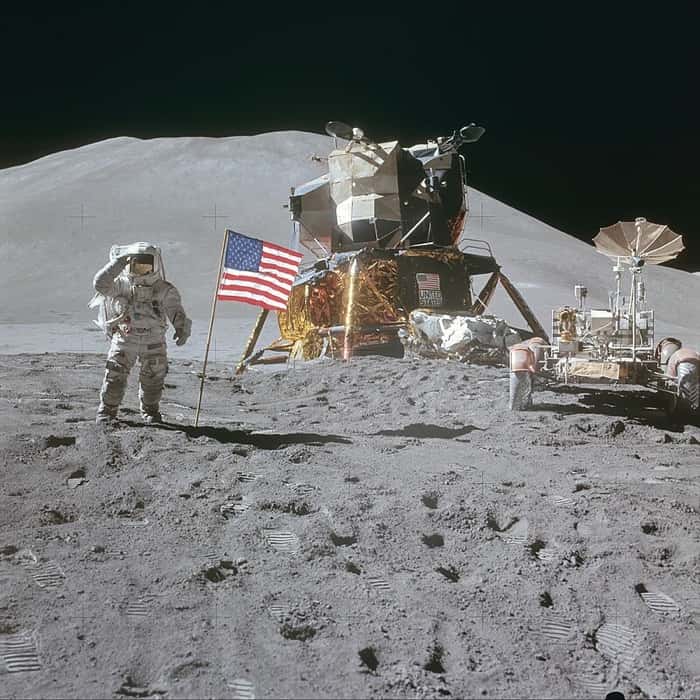
On July 31st, 1971, history was made when a rover touched down on the lunar surface and drove across it for the very first time. The mission responsible for this remarkable achievement was Apollo 15. Tragically, before this success became reality, 14 astronauts had lost their lives in space flight attempting to reach the Moon. Commander Scot honored their memory by inscribing each of their names on a small plaque placed behind the rover.
While the Apollo 15 crew had several objectives awaiting them on the Moon, their very first order of business was actually getting some rest. Rather than jumping straight into exploration after landing, the astronauts chose to sleep and conserve their energy for the work ahead.
Preparation was everything for the Apollo 15 crew, and their thorough, methodical approach spoke volumes about how seriously they took the mission. Their checklist included inspecting their spacesuits for any changes, putting the lunar rover through its paces, getting the lunar communication relay unit operational, and assembling the ground-controlled TV equipment. Long before they ever set foot on the Moon, astronauts David Scott, Alfred Worden and James Irwin had sharpened their driving abilities using a lunar rover simulator out in the Mojave Desert near China Lake.
Taking the rover for a spin on the lunar surface threw some real curveballs at the Apollo 15 crew, pushing both their courage and their ability to think on their feet. The journey was anything but smooth — the front wheel drive gave out entirely during the drive. With the Moon's unforgiving landscape full of small rocks and mini craters at every turn, the test drive proved to be a demanding yet ultimately triumphant piece of exploration.
Among the crew's other key objectives was deploying particles, fields, and subsatellites into lunar orbit ahead of their return trip to Earth. The purpose of this subsatellite was to study the Moon's mass and gravity, analyze the particle composition of lunar space, and examine the interaction between the Moon's magnetic field and Earth's.
In a quiet, personal gesture before his departure, astronaut David Scott left a small, red-covered Bible resting on the control panel of the Apollo 15 lunar rover. The mission, which launched on July 26th, wrapped up successfully when the Apollo 15 crew splashed back down on Earth on August 7th.
Several records fell during the Apollo mission. These included the most extended duration spent on the Moon — about 18 hours and 37 minutes across 3 EVAs — as well as the longest surface distance traveled, covering about 17.5 miles.