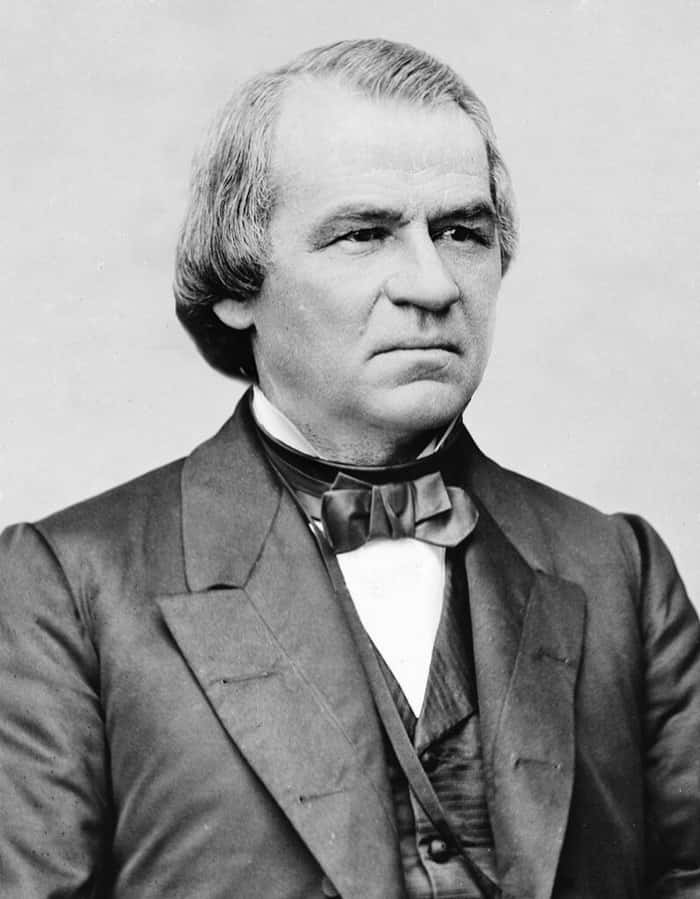
On July 31, 1875, Andrew Johnson — the nation's seventeenth president — died at age 66. His death followed a lengthy horseback journey through sweltering heat to see his daughter in Elizabethton, Tennessee, during which he suffered a devastating stroke from which he never recovered. Johnson was laid to rest in Greenville, Tennessee, his hometown, his body draped in an American flag with his well-worn copy of the United States Constitution tucked beneath his head as a pillow. The site where he was buried would eventually be designated the National Cemetery of Andrew Johnson.
Few presidencies have sparked as much controversy as that of Andrew Johnson. Serving as Abraham Lincoln's vice president, Johnson was thrust into the nation's highest office following Lincoln's assassination. From 1865 to 1869, he led a country grappling with the enormous challenges of the post-Civil War period, tasked above all with bringing the seceded states back into the Union. While he was a vocal opponent of slavery — famously calling it a "cancer" on the United States — and backed its abolition, critics took him to task for doing far too little to safeguard the rights and freedoms of formerly enslaved people. His approach to Reconstruction in the southern states, widely seen as hasty and overly forgiving, only intensified the backlash. These tensions boiled over in 1868, when the House of Representatives impeached him for dismissing officials who stood against his policies and for his clashes with Congress over Reconstruction. The Senate, however, ultimately acquitted him. Johnson pursued the Democratic nomination to win a second presidential term but failed to secure it.
Fun Facts about President Andrew Johnson:
- As a young boy, Andrew Johnson fled the home where his mother had placed him as an apprentice to a local tailor. Undeterred, he went on to launch his own tailoring enterprise, which proved remarkably successful and eventually enabled him to invest in real estate.
- For much of his early adulthood, Johnson could neither read nor write. It was his wife, Eliza, who taught him both skills after they were married.
- Though he failed to win his party's nomination for a second presidential term, Johnson secured election to the U.S. Senate in 1875 — a distinction that made him the only former U.S. President to go on to serve in the Senate.
- Johnson championed the interests of the "common man" and built his political platform in direct opposition to what he called "plantation aristocracy."
- He left behind specific instructions to be buried alongside an American flag and his personal copy of the United States Constitution — wishes that were honored following his death in 1875.