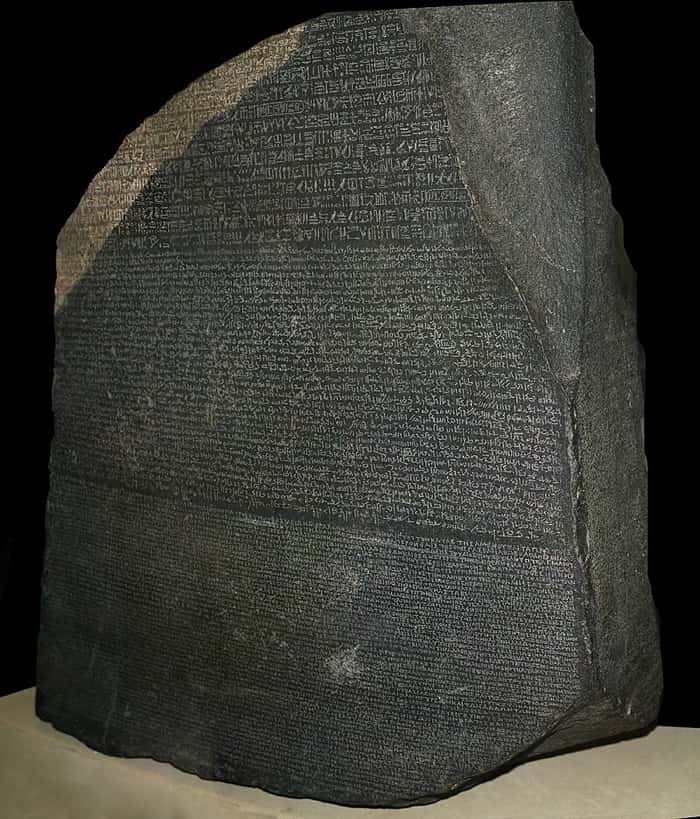
For hundreds of years, the enigmatic drawings scattered across ancient Egypt captivated scholars who desperately sought to unlock their secrets. These symbols—called hieroglyphs—appeared everywhere throughout the region, adorning buildings, monuments, and tombs, yet no one possessed the tools to decode the information they held. The ability to read or write this lost language had faded from human knowledge long ago. Then came July 3, 1799, when everything shifted dramatically: French soldiers unearthed the Rosetta Stone, a discovery that would ultimately hand researchers the crucial key to cracking the ancient language.
Napoleon Bonaparte had launched his invasion of Egypt with a French army in late 1798, driven by ambitions that went beyond mere territorial control—he also wanted to explore the region's deep and storied cultural heritage. Stationed near the town of Rosetta, his soldiers were engaged in repair work on a damaged fort when something remarkable came to light. One soldier, Pierre-François Bouchard, spotted elaborate inscriptions carved into a stone and immediately grasped how significant they might be for decoding the hieroglyphs that had puzzled researchers for so long. Bouchard's keen recognition, along with the unearthing of the stone itself, would go on to transform our understanding of ancient Egypt and bring relief to centuries of scholarly frustration.
Roughly 3.5 feet tall and more than 2 feet wide, the Rosetta Stone is a large, irregularly shaped slab that carries text written in three distinct languages: ancient Greek, Demotic script, and ancient Egyptian hieroglyphs. Because scholars already had a solid command of ancient Greek, they could use it as a bridge to work out the meaning and function of the hieroglyphic symbols. The stone can be found today on display at the British Museum in London.