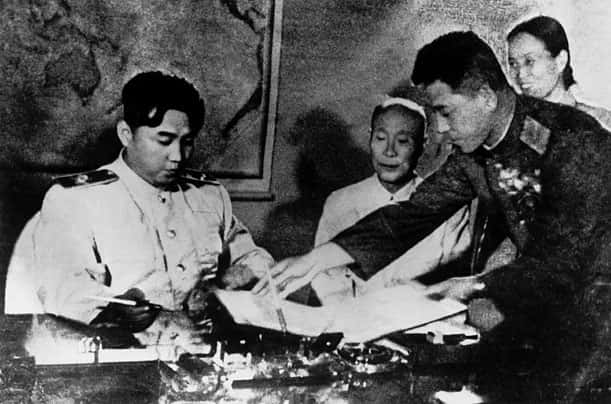
In the aftermath of World War II, geopolitical friction escalated rapidly, particularly between the United States and the Soviet Union. When it came time to oversee the departure of Japanese forces from Korea, the two powers struck a deal to split the peninsula at the 38th parallel — the Soviet Union would control the northern half, and the United States would administer the southern half. It didn't take long for this arrangement to become deeply contentious. The core problem? The two superpowers held fundamentally incompatible visions for Korea's future governance. While the United States championed democracy, the Soviet Union sought to install a communist regime. This clash of ideologies set the stage for outright war, ignited when North Korea launched an invasion of the South. From 1950 to 1953 — a grueling three years — the Korean War raged on. It was finally brought to a close on July 27, 1953, when the Korean Armistice Agreement was signed, officially putting an end to the hostilities.
While the Korean Armistice Agreement succeeded in stopping the bloodshed, it was not, in any real sense, a peace agreement. Its provisions called for an immediate ceasefire, bringing all active military operations and combat on both sides to a standstill. Beyond that, the agreement created a Demilitarized Zone — a 4,000-meter buffer separating North and South Korea that functions as the boundary between the two nations. Prisoners of war held by either side were also required to be released under its terms. To ensure compliance, a commission made up of neutral parties was established to monitor and enforce the agreement's provisions. Even now, more than 28,000 active U.S. military troops remain stationed in South Korea, keeping watch over the security situation that persists along the divided peninsula.
The legacy of the Korean Armistice Agreement is anything but straightforward. It undeniably achieved its primary goal — bringing active combat between North and South Korea to a halt. Yet deep-seated tensions have never truly faded, and sporadic fighting along with violations of the truce continue to flare up. Perhaps most strikingly, because the agreement was never a formal peace treaty, the Korean War remains technically unresolved to this day.