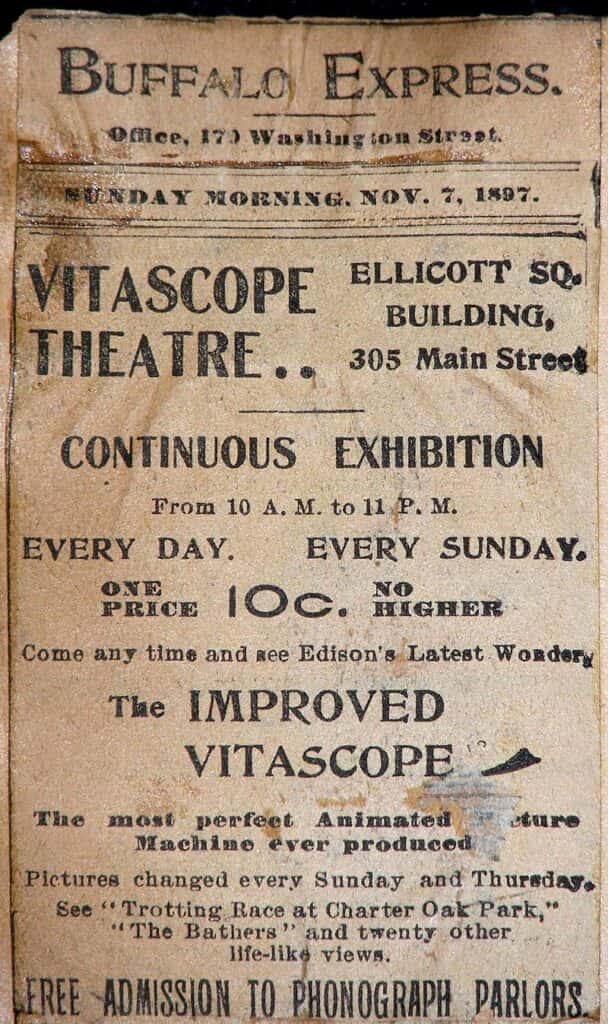
On this day in 1896, a groundbreaking chapter in American entertainment began when the Vitascope Hall threw open its doors in New Orleans. As the first for-profit movie theater in the United States, it delivered something audiences had never experienced before. Serving as a showcase for films produced in France and England, the venue brought an entirely new art form to American viewers. Remarkably, the theater's story intertwines with some of history's most influential figures — names like Thomas Edison, the Mayo brothers, and William Randolph Hearst all feature in the Vitascope Hall's legacy. While the venture initially thrived, dazzling patrons with novel European motion pictures, its fortunes didn't last forever. The majority of those foreign films simply failed to resonate with American audiences, and patronage fell off rapidly. Curiously, though, the theater also enjoyed a surge of success in its final days of operation.
Facts about 26,1896- Vitascope Hall
- Pioneering brothers Robert and Jules Mayo were the visionaries behind the theater. They etched their names into history in 1896 by becoming the first to employ the Vitascope — a groundbreaking film projector capable of casting moving images onto a stage.
- Situated on Lyon Street near St. Charles Avenue in New Orleans, the Vitascope Hall occupies a remarkable place in cinematic history. The location was no accident — its closeness to the lively St. Charles Avenue made it a strategic choice for drawing large crowds. On July 26, 1896, the theater welcomed its first patrons, ushering in what would become an entirely new era of public entertainment.
- Business declined rather quickly because the European films being screened largely failed to connect with American audiences. Still, a good number of people had visited the Vitascope Hall at least once during its run.
- Among the most colorful personalities tied to the theater was Auguste Joseph Deyss, one of New Orleans's most notorious characters. He held ownership of the Vitascope Hall and was deeply involved in running and managing the venue, lending it a distinctive character and charm all its own.
- Auguste Joseph Deyss was quite the larger-than-life figure in New Orleans. His eclectic résumé included everything from performing circus tricks to working as a bouncer, and he even served as a road agent for gambling hells and brothels scattered around the city.
- A second Vitascope Hall eventually launched at 1048 Canal Street in New Orleans, operating between November 15 and December 16, 1901. Tragically, the building was destroyed by fire on December 31, 1903.