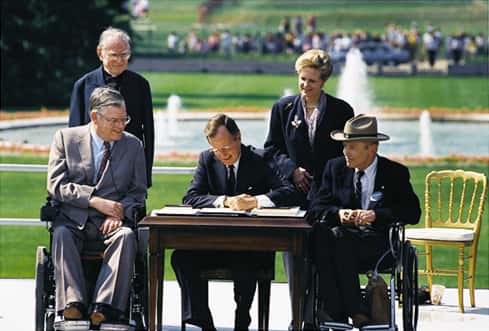
When President Richard Nixon signed the Rehabilitation Act of 1973, it marked a groundbreaking moment for disability rights — the first official law designed to protect people with disabilities. However, the law's language left room for interpretation, and that ambiguity invited legal challenges over the scope of its protections. Despite the considerable progress it represented, the Rehabilitation Act fell short of fully tackling discrimination against individuals with disabilities. Recognizing the need to build upon these earlier protections, a new piece of legislation was proposed — one that became a key part of George H.W. Bush's campaign platform. That vision became reality on July 26, 1990, when President George H.W. Bush put his signature on the Americans with Disabilities Act (ADA), officially making it law.
So what exactly does the ADA do? At its core, it's a civil rights law designed to stamp out discrimination against individuals with disabilities, guaranteeing equal opportunities and benefits regardless of a person's disability status. For employers, the act establishes clear obligations: they must provide reasonable accommodations for all employees, covering everything from hiring and firing to promotion and training practices. But the law's reach extends well beyond the workplace. Public facilities — think restaurants, hotels, and stores — are required to ensure accessibility for individuals with disabilities under the ADA. Transportation systems, buses and subways included, must likewise be made accessible to all.
Held on the South Lawn of the White House, the ADA's signing ceremony was nothing short of momentous. Among those present were some of the most prominent champions of disability rights, including Evan Kemp, Chairman of the Equal Employment Opportunity Commission, and Justin Dart, Chairman of the President's Committee on Employment for People with Disabilities. To this day, the act stands as the most important advancement in disability rights legislation and in the broader effort to dismantle discrimination against people with disabilities.