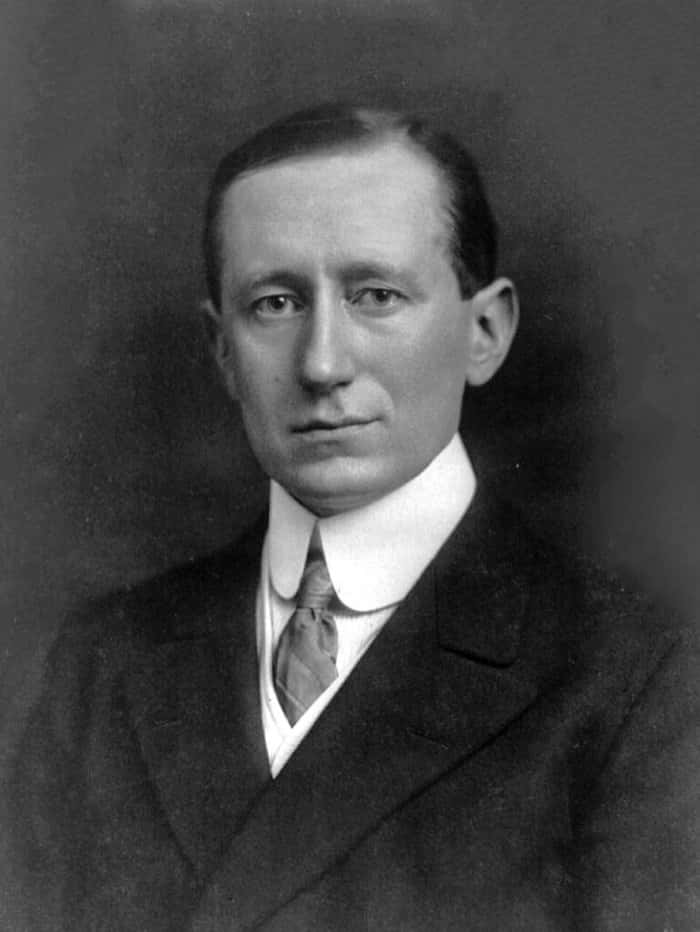
It was on July 2, 1897, that Guglielmo Marconi — the Italian inventor widely celebrated as the "Father of the Radio" — secured a patent for his groundbreaking wireless telegraphy system. After years of dedicated experimentation, he was awarded a British patent titled "Improvements in Transmitting Electrical Impulses and Signals." This achievement is broadly recognized as a landmark moment in the evolution of radio communication.
Born in Bologna, Italy, in 1874, Guglielmo Marconi never received formal schooling — yet he would go on to hold hundreds of patents for his inventions over the course of his lifetime. His education came through a series of private tutors arranged by his parents, and it was during these early years that he cultivated a deep fascination with physics and chemistry. As a young adult, he sat in on classes at a university in Bologna purely for the love of learning, though he was never officially enrolled as a student.
During the 1890s, while he was still a teenager, Marconi threw himself into experiments centered on sending telegraph messages without the need for connecting wires. The idea itself wasn't entirely new — others had been exploring similar concepts for several years already. What set Marconi apart, however, was that he became the first person to successfully build a device that could transmit messages wirelessly, laying the foundation for what would prove to be an extraordinarily valuable communication system.
Fun Facts about Guglielmo Marconi:
- Since his landmark 1897 patent for the wireless telegraphy system, nearly 800 patents have been awarded to Marconi and the Marconi company collectively.
- Marconi was offered free passage aboard the Titanic, yet he opted to travel on a different ship a few days before its departure.
- In 1909, Marconi was honored with a Nobel Prize in recognition of his contributions to wireless technology.
- He pioneered the first transatlantic radio signal transmission, an innovation credited with saving lives and improving safety at sea.