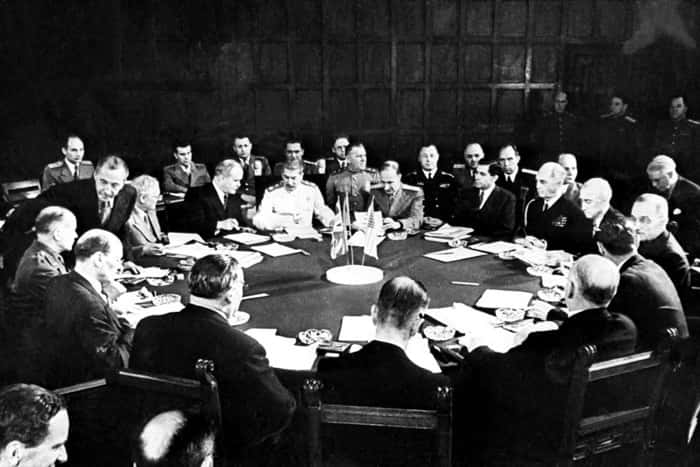
Germany's surrender to the Allied powers in May 1945 left Europe reeling from massive destruction and triggered a dramatic realignment of global power. In response, the Allies came together to hash out how postwar Europe would be reorganized—especially the future of Germany—and to coordinate their approach to the still-raging conflict with Japan. On July 17, 1945, these discussions formally got underway in Potsdam, Germany, at what would become known as the Potsdam Conference, a pivotal gathering where the Allied powers laid out their vision for a peaceful world order.
Three towering figures of the era sat at the negotiating table: U.S. President Harry Truman, British Prime Minister Winston Churchill, and Soviet leader Joseph Stalin. Together, they tackled a sweeping agenda tied to the postwar landscape. Chief among their concerns was what to do with Germany. The leaders set objectives for demilitarizing and disarming the nation and reached formal agreements on carving it into occupation zones. Four zones were created, with each one assigned to the United States, the United Kingdom, France, and the Soviet Union respectively. The prosecution of Nazi war criminals also featured prominently in their deliberations. Beyond the German question, the conference turned its attention to Japan and the ongoing Pacific war. The result was the "Potsdam Declaration," a joint ultimatum demanding Japan's unconditional surrender or face the utter destruction of their country.
By charting the course for Germany in the wake of the Nazi regime's collapse and establishing the blueprint for dividing the country among the Allied Powers, the Potsdam Conference proved instrumental in shaping World War II's final chapter. Yet beneath the surface of cooperation, cracks were forming—tensions between the Western Allies and the Soviet Union became increasingly apparent. Meanwhile, Japan faced mounting pressure to capitulate, with veiled references to a "new destructive weapon" in American hands. Unbeknownst to many at the table, the Soviet Union had already learned of this weapon through espionage, effectively planting the seeds for what would soon become the Cold War.