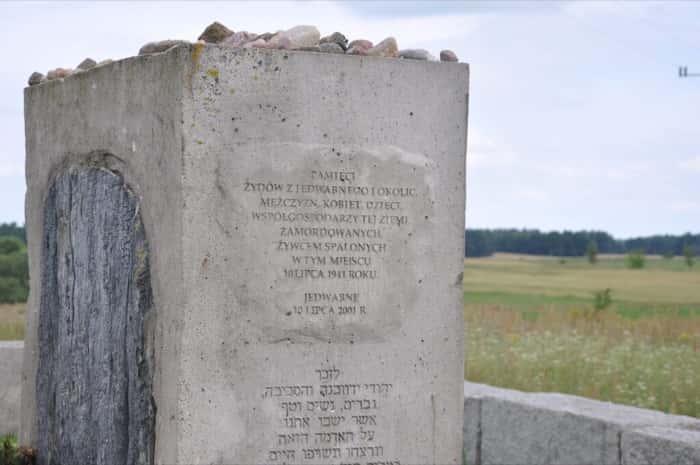
On July 10, 1941, in the town of Jedwabne, Poland, one of the most horrifying chapters of the early Holocaust unfolded — a massacre of Polish Jews that would remain shrouded in misattributed blame for decades.
What makes the Jedwabne Pogrom so deeply unsettling isn't just its gruesome nature — it's the truth about who carried it out. For years, the world pointed the finger at the Germans as the ones responsible for the bloodshed in Jedwabne. But the real story turned out to be far more disturbing: it was Polish civilians themselves who perpetrated the unthinkable horrors visited upon their Jewish neighbors on that day in 1941.
Here are a few facts you should know:
Jedwabne Pogrom Facts
- The massacre unfolded in Poland while the country was under German occupation.
- Jewish residents at that time represented about 40% of the local population in Jedwabne.
- Polish locals turned on their Jewish neighbors — men, women, and children without distinction — accusing them of having ties to the German Soviets.
- The killing methods employed by the perpetrators were varied and brutal, ranging from stoning and stabbing to burning victims alive.
- The death toll is believed to be around 340 Polish Jews.
- Responsibility for the atrocity was disputed for decades, with blame bouncing between the Nazis and local Polish civilians. Eventually, the president of the Republic of Poland stepped forward with a public apology and dedicated a monument bearing the inscription: "In memory of the Jews of Jedwabne and surrounding areas, men, women, and children, fellow-dwellers of this land, murdered and burned alive at this site on July 10, 1941."
- Princeton University historian Jan T. Gross brought the events of July 10, 1941 into broader public consciousness with his book Neighbours, published in 2000, which provides a detailed examination of what transpired that day.
- The Jedwabne massacre stands as one of the most gruesome episodes in the history of the Holocaust.