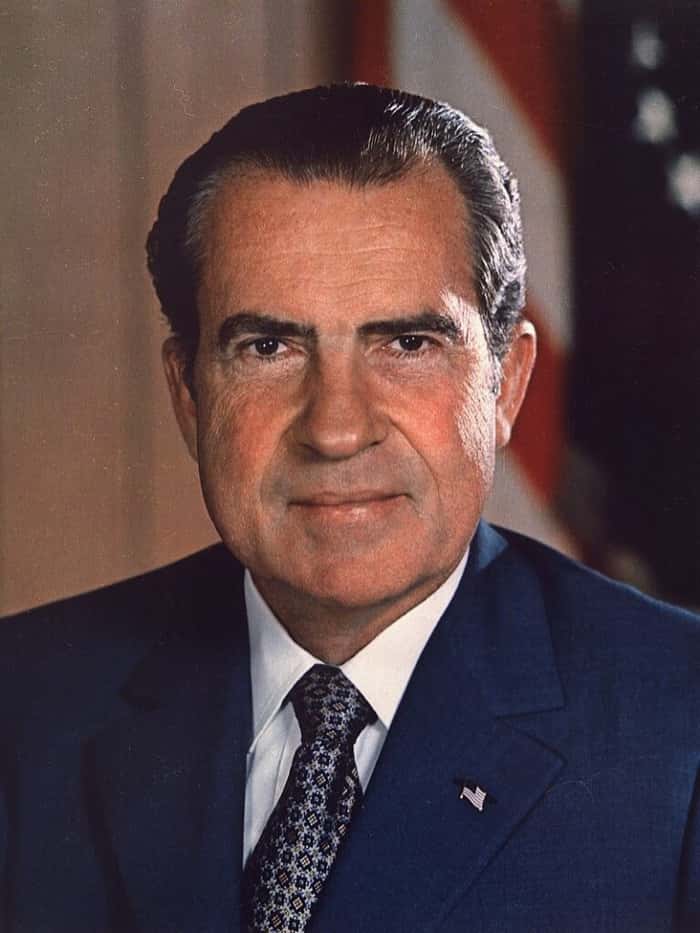
On January 9, 1913, in Yorba Linda, California, a boy named Richard Milhous Nixon entered the world as the second of five sons. His family was modest and hardworking, scraping by while running a small lemon ranch. From the very beginning, his life was shaped by financial hardship, personal tragedy, and a fierce determination to succeed.
Resilience wasn't something Nixon learned from books—it was forged through experience. He lost two brothers at a young age, and his parents, Frank and Hannah Nixon, raised him with an unwavering emphasis on perseverance and ambition. At Whittier College, a small Quaker institution close to where he grew up, Nixon distinguished himself as a strong student while also revealing an early talent for politics. A scholarship took him to Duke University School of Law, where he graduated third in his class in 1937.
Nixon met Thelma "Pat" Ryan through a community theater production, and the two married in 1940. She was a schoolteacher at the time.
The year 1946 marked the true beginning of Nixon's political ascent. He won a seat in the U.S. House of Representatives by defeating a five-term Democratic incumbent. His work on the House Un-American Activities Committee during the late 1940s—especially his pursuit of Alger Hiss, a State Department official accused of being a Soviet spy—thrust him into the national spotlight. That momentum carried him to the Senate in 1950, and just two years later, he joined Dwight D. Eisenhower's ticket as vice president.
As vice president, Nixon became a globe-trotting representative of American anti-communist resolve during the Cold War. His verbal sparring with Soviet leader Nikita Khrushchev, known to history as the "Kitchen Debates," showcased both his rhetorical sharpness and his talent for strategic maneuvering.
A heartbreakingly close loss to John F. Kennedy in the 1960 presidential race could have ended Nixon's political career for good. Instead, he mounted one of the most impressive comebacks in American political history, claiming the presidency in 1968 and securing re-election in 1972. Yet his achievements would be forever eclipsed by the Watergate scandal, which forced his resignation in 1974—making him the first and only U.S. president to voluntarily leave office.