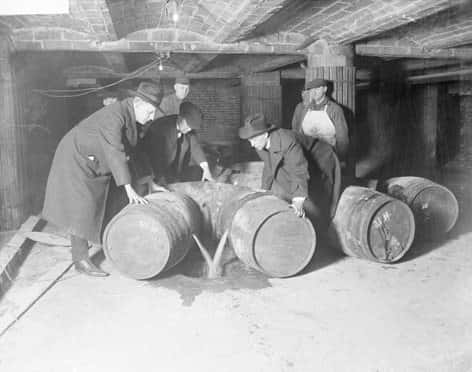
When Acting Secretary of State Frank L. Polk put pen to paper on January 29, 1919, he certified what would become one of the most consequential — and controversial — changes to the U.S. Constitution. The Eighteenth Amendment was now officially part of the nation's highest law, setting the stage for Prohibition by outlawing the manufacture, sale, and transportation of intoxicating liquors across the country.
The groundwork for this dramatic shift had been laid over many decades. From the 19th century well into the early 20th century, temperance organizations worked relentlessly to reshape American attitudes toward alcohol. Their arguments drew on moral, health, and social concerns, and they built a broad coalition determined to curb or completely eliminate alcohol consumption within the community at large.
Their influence eventually reached a tipping point. In December 1917, Congress formally proposed the Eighteenth Amendment, sending it to the states for approval. To become law, the amendment needed ratification by three-fourths of the states.
Ratification Process
- State Approvals: Support came quickly, and by January 16, 1919, the required number of states had ratified the amendment.
- Official Certification: The ratification was officially certified on January 29, 1919, by Acting Secretary of State Frank L. Polk, formally embedding the Eighteenth Amendment into the Constitution.
- Effective Date: A built-in one-year delay meant that Prohibition wouldn't actually begin until January 17, 1920, giving the nation time to prepare for the sweeping change.
Key Provisions of the Eighteenth Amendment
- Section 1: Banned the manufacture, sale, or transportation of intoxicating liquors intended for beverage purposes throughout the United States and its territories.
- Section 2: Gave both Congress and the state's concurrent power to enforce the amendment via appropriate legislation.
The experiment wouldn't last forever. On December 5, 1933, the Twenty-First Amendment was proposed and ratified, wiping the Eighteenth Amendment from the books and bringing Prohibition to a close.
Looking back, the ratification of the Eighteenth Amendment on January 29, 1919, stands as a remarkable chapter in the American story. It revealed deep societal values while exposing the inherent complexities of using law to regulate personal behavior. That Prohibition was ultimately repealed speaks to the ever-evolving nature of constitutional law and public policy — a reminder that even amendments to the Constitution are not necessarily permanent.