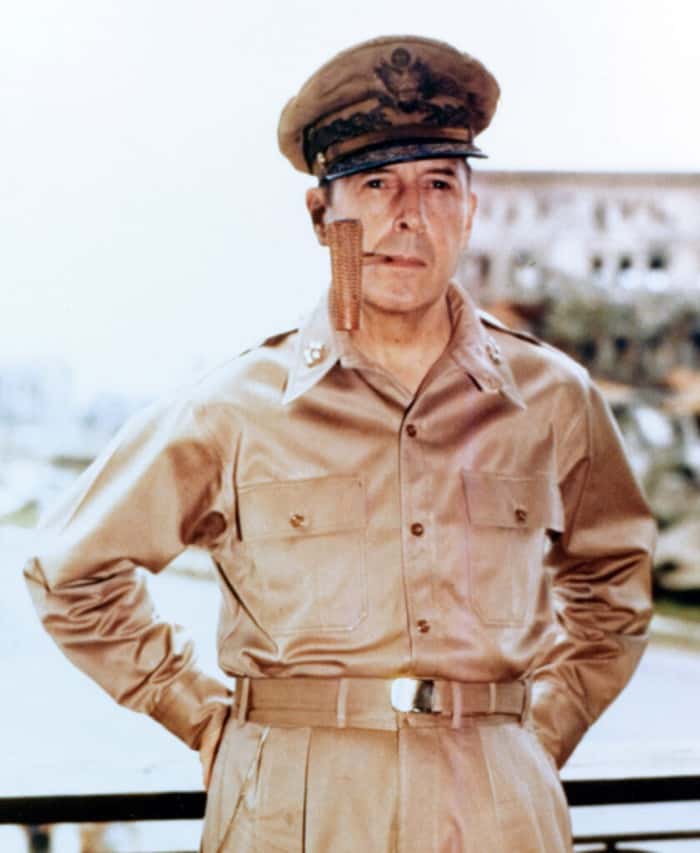
On January 26, 1880, in Little Rock, Arkansas, a future titan of American military history entered the world: Douglas MacArthur. Military service ran deep in his blood — his father, Arthur MacArthur Jr., had distinguished himself as a Union hero during the Civil War, a significant event in American history, and went on to build an impressive career as a decorated Army officer. Meanwhile, his mother, Mary "Pinky" Hardy, hailed from a prominent family in Norfolk, Virginia.
Growing up immersed in the rhythms of Army life, MacArthur moved with his family from post to post across the United States. When he enrolled at the U.S. Military Academy at West Point in 1899, it surprised no one that he thrived there — excelling in his studies and standing out as a natural leader. By 1903, he had graduated first in his class, a remarkable achievement for a young man of his age that signaled the extraordinary career ahead of him.
Military Career Highlights
- World War I Service: Serving on the Western Front, MacArthur distinguished himself through repeated acts of bravery, collecting multiple commendations and ascending to the rank of brigadier general.
- Interwar Period: Between the wars, he took on a series of influential roles. As Superintendent of West Point, he drove progressive reforms through the institution. He then served as Chief of Staff of the U.S. Army from 1930 to 1935.
- World War II Leadership: In his capacity as Supreme Commander of Allied Forces in the Southwest Pacific, MacArthur became a central figure in the Pacific theater. Perhaps most memorably, he made good on his famous promise to return to the Philippines, a moment that cemented his place in the public imagination.
- Postwar Japan: After Japan's surrender, MacArthur took charge of the country's occupation and reconstruction, guiding the implementation of democratic reforms that fundamentally reshaped the nation.
- Korean War Command: Appointed Commander of United Nations forces when the Korean War erupted, MacArthur initially achieved significant success. However, his tenure ended abruptly when he was relieved of command in 1951 over policy disagreements — specifically, his public criticism of the Truman administration's war strategy and his push for a more aggressive approach, including the use of nuclear weapons.
Legacy
Both brilliant strategist and polarizing figure, MacArthur left an indelible mark on key military campaigns through his leadership and strategic acumen. Yet his assertive personality and periodic confrontations with political leaders ensured he remained a lightning rod for debate. When he died on April 5, 1964, the legacy he left behind was as layered and complex as the man himself — one that scholars and historians continue to examine and discuss, reflecting the profound depth of his impact on history.
The MacArthur Memorial in Norfolk, Virginia, stands as a rich resource for anyone eager to explore his life and lasting influence in greater detail, housing extensive exhibits and materials dedicated to his memory.