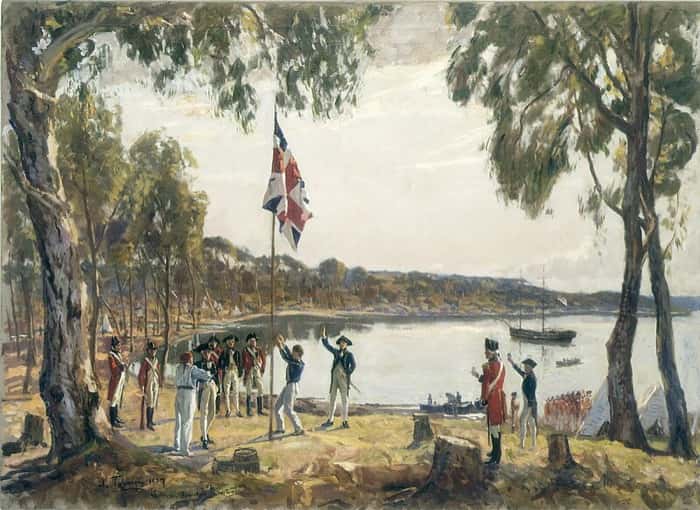
On January 26, 1788, Captain Arthur Phillip led the British First Fleet to Sydney Cove, where he founded a penal colony that would forever change the trajectory of an entire continent. That single day launched the era of European settlement in Australia. Comprising eleven ships packed with convicts, supplies, and soldiers, the fleet had crossed vast ocean expanses to reach these distant shores. The colony's establishment reshaped both the physical landscape and the cultural identity of Australia in ways that still resonate today. January 26 now serves as a powerful and complex touchstone in the nation's ongoing reckoning with its origins.
Background
After the American Revolutionary War severed access to its former territories across the Atlantic, Britain found itself without a destination for its convicted criminals and began searching for an alternative.
Lieutenant James Cook had explored Botany Bay, Australia, back in 1770, and by 1786 the British government had seized on this knowledge to designate a new penal colony there. The move served a dual purpose: easing the pressure on dangerously overcrowded prisons at home while simultaneously planting a strategic foothold in the Pacific.
The First Fleet
- An extraordinary logistical feat, the First Fleet consisted of 11 ships carrying more than 1,400 individuals — a mixed assembly that included approximately 736 convicts alongside officers, marines, and seamen.
- Departing England in May 1787, the fleet endured a punishing eight-month ocean crossing that tested every soul aboard. They finally reached Botany Bay between January 18 and 20th, 1788, completing one of the most remarkable voyages of the era.
When Captain Phillip assessed Botany Bay firsthand, he quickly judged it inadequate — the soil was poor and fresh water scarce. Undeterred, he pushed northward in search of something better and soon identified Port Jackson, with Sydney Cove standing out as a far more promising site for settlement.
On this date — now observed as Australia Day — Phillip and his crew set to work at Sydney Cove, clearing the land and constructing the first shelters of what would become a new society.
Impact on Indigenous Populations
For the Eora Nation, the Aboriginal people who had long called the Sydney area home, the British arrival brought catastrophic consequences. Their land was taken from them, unfamiliar diseases swept through their communities, and their traditional way of life suffered severe and lasting disruption.
Significance
The founding of the Sydney Cove settlement proved to be a turning point that set in motion decades of convict transportation to Australia — a practice that would not cease until 1868. Over that span, enormous numbers of convicts were shipped to the continent, fundamentally altering the course of Australian history.
More broadly, this moment ignited the process of European colonization and established the groundwork upon which modern Australian society would eventually be built.