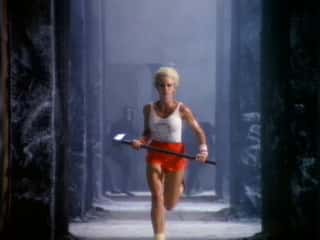
What if one of television's most iconic commercials had never seen the light of day? That nearly happened with Apple's legendary "1984" spot, which first aired during the Super Bowl on January 24, 1984. Only a gutsy act of corporate rebellion saved it from being shelved permanently before audiences ever laid eyes on it.
Crafted as a tribute to George Orwell's dystopian masterpiece, 1984, the commercial served as the launchpad for Apple's debut home computer. Viewers are thrust into a bleak world populated by rows of identical figures clad in dreary gray attire, their gazes fixed on an enormous screen. On that screen, a totalitarian figure delivers an impassioned speech championing total conformity and the eradication of independent thought — a figure meant to represent IBM, which dominated the home computer landscape at the time. Then, out of nowhere, a woman sprints into the hall wearing vivid athletic clothing emblazoned with a Macintosh computer graphic, riot gear-clad police officers in hot pursuit behind her. She launches a sledgehammer straight into the massive screen, which explodes in a burst of destruction, symbolically freeing the mesmerized crowd from mental captivity.
You might assume that having the legendary Ridley Scott at the helm would have thrilled Apple's board of directors, but they were anything but enthusiastic. Their reaction? Fire the ad agency, bury the commercial entirely, and offload the Super Bowl airtime they'd already purchased to recoup whatever money they could. Enter a determined ad agency executive with deep faith in the spot's potential — this executive went through the motions of trying to sell off the time slot but ultimately came back to the board claiming the sale simply couldn't be completed in time. Backed into a corner, the board reluctantly allowed the ad to run, and it debuted to widespread critical praise. In the wake of its broadcast, Apple moved more than $3 million in Macintosh sales, and the company came to regard the commercial as a major triumph. The story didn't end there, though — before the year was out, George Orwell's estate alleged the ad violated copyright law and hit Apple with a cease-and-desist letter.