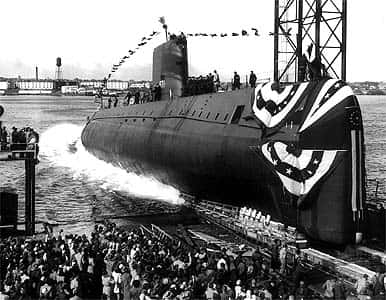
Imagine a vessel so groundbreaking that it rewrote the rules of naval combat overnight. That vessel was the USS Nautilus (SSN-571) — the world's first nuclear-powered submarine, launched on January 21, 1954, in Groton, Connecticut. This extraordinary feat of engineering didn't just make headlines; it permanently transformed how nations thought about warfare at sea.
A New Era in Naval Technology
- Admiral Hyman G. Rickover, widely known as the "Father of the Nuclear Navy," was the visionary force behind the USS Nautilus.
- Unlike conventional diesel-electric submarines, which must surface frequently to recharge batteries, the Nautilus harnessed a nuclear reactor that allowed it to remain submerged for dramatically longer periods.
- Work on the submarine got underway in 1952 at the General Dynamics Electric Boat Division in Groton, Connecticut.
Launch Day: A Pivotal Moment in History
Thousands of dignitaries, military leaders, and engineers assembled on January 21, 1954, to witness history unfold. First Lady Mamie Eisenhower performed the time-honored christening, smashing a champagne bottle against the hull and declaring, "I christen thee Nautilus" — words that heralded a bold new frontier. Moments later, the submarine glided into the Thames River, and with it, an entirely new chapter in naval history began.
Record-Breaking Achievements
By 1955, the USS Nautilus was fully operational, quickly shattering records for speed, distance, and underwater endurance.
- Its most celebrated accomplishment came in 1958, when it completed the first-ever submerged transit of the North Pole — a feat that showcased the remarkable possibilities of under-ice navigation. Known as Operation Sunshine, the mission captivated audiences worldwide and cemented the Nautilus as an enduring symbol of the Cold War era.
- Over the course of its career, the submarine logged more than 500,000 nautical miles, decisively proving that nuclear-powered vessels were not only feasible but formidable.
USS Nautilus's Legacy
Submarine warfare was fundamentally reshaped by the Nautilus. Its capacity to remain submerged indefinitely gave the U.S. Navy entirely new strategic dimensions that had previously been unimaginable.
- The vessel paved the way for today's fleet of modern nuclear-powered submarines, which continue to serve as vital assets for both national defense and scientific exploration.
- Following its decommissioning in 1980, the Nautilus found a second life as a museum ship at the Submarine Force Library and Museum in Groton, Connecticut. There, visitors can step inside its historic corridors and get a firsthand sense of what life was like aboard this revolutionary craft.