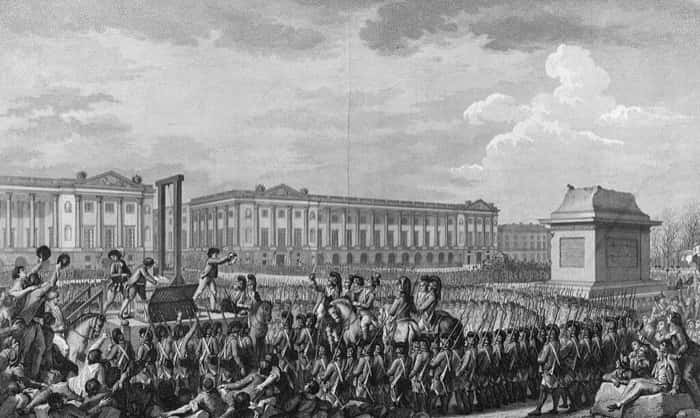
On January 21, 1793, the people of revolutionary France did the unthinkable: they put their own king to death. King Louis XVI of France met his end at the guillotine in a public square in Paris, an act that would reverberate far beyond the nation's borders. The French Revolution had entered its most radical phase, and the revolutionary government now saw the monarch not as a leader but as an embodiment of oppression—a direct threat to the fragile republic they were building. Across the continent, Europe's ruling monarchies watched in horror, gripped by the fear that revolutionary fervor could topple their own thrones. More than just the definitive conclusion of royal authority in France, this single act of regicide set off a chain reaction, fueling further radicalism within the country and reshaping the political landscape of Europe for years to come.
The Fall of a King
- At just 20 years old, Louis XVI took the French throne in 1774.
- France found itself teetering on the edge of financial ruin by the late 1780s, drained by years of extravagant expenditure and the enormous costs of supporting the American Revolutionary War.
- Fueled by deep frustration over economic inequality, crushing taxes, and authoritarian governance, the French Revolution burst onto the scene in 1789.
The Path to the Guillotine
- Desperate to escape and hoping to gather support from loyalists and foreign allies, Louis XVI and his family made a bold attempt to flee France in 1791. Their plan unraveled when they were intercepted and detained at Varennes.
- France formally dissolved its monarchy in September 1792, stripping the king of his title and reducing him to Citizen Louis Capet.
- The National Convention placed Louis on trial, charging him with "conspiring against the liberty of the nation" and providing aid to France's enemies throughout the revolution.
- What followed was a fierce and heated debate among the delegates, culminating in a decisive vote for execution—361 in favor of death versus 288 opposed, with many abstentions.
Execution Day
- The Place de la Révolution (now Place de la Concorde) served as the stage for Louis XVI's death by guillotine.
- Ascending the scaffold with composure, he spoke his last words to those gathered: "I die innocent of all the crimes imputed to me; I pardon the authors of my death, and I pray to God that the blood you are about to shed will never fall upon France."
- At 10:22 a.m., the blade dropped, cutting the monarchy's ancient claim of divine authority once and for all.
Aftermath and Legacy
Europe found itself deeply divided in the wake of Louis XVI's execution. Monarchies across the continent condemned the French Republic with fury, while revolutionaries celebrated what they considered a triumph for human liberty. This pivotal moment ushered in the Reign of Terror (1793–1794), a dark chapter defined by widespread executions carried out under the direction of Maximilien Robespierre and the radical Jacobins.
- More than an act of punishment, the death of Louis XVI became a powerful symbol of the Revolution's unwavering resolve to tear down the structures of the old order and forge a new society built on egalitarian principles.
This day stands as one of the great turning points in world history.