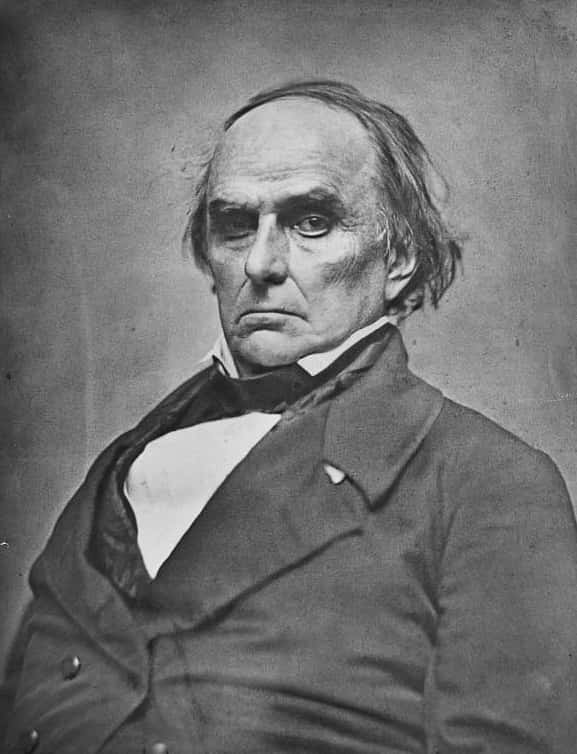
On January 18, 1782, in Salisbury, New Hampshire, Daniel Webster came into the world — a man who would go on to become one of the most commanding presences in American history. A gifted wordsmith, a fierce champion of the Constitution, and a towering figure in law and governance, Webster left behind a legacy as a statesman, lawyer, and orator that resonates even now.
Interesting Facts:
- Webster's roots were humble — he was raised in a farming family with limited means.
- Even as a child, Webster showed an extraordinary hunger for knowledge. His family, despite facing financial hardships, recognized and nurtured this gift. That early drive would prove to be the foundation of everything he later accomplished.
- In 1801, Webster completed his studies at Dartmouth College, where his natural flair for public speaking first became evident — a skill that would come to define his entire career.
- Following his study of law, Webster gained admission to the bar in 1805 and went on to build a thriving legal practice.
- Webster's courtroom brilliance shone most brightly in landmark Supreme Court cases like Dartmouth College v. Woodward (1819) and McCulloch v. Maryland (1819). These weren't mere victories — they were transformative moments that helped mold constitutional law, underscoring both his legal genius and his lasting influence on the judiciary.
- Beginning his political journey as a Federalist before eventually joining the Whig Party, Webster held seats in both the U.S. House of Representatives and the Senate, and also served as Secretary of State.
- Beyond his political accomplishments, Webster earned widespread admiration for the sheer power of his words. His gift for mesmerizing audiences through eloquent, persuasive speeches became one of the hallmarks of his public life.
- In 1830, Webster delivered his celebrated 'Second Reply to Hayne,' a passionate rebuttal to Senator Robert Hayne's case for states' rights. This stirring defense of both the Union and the Constitution stands as one of the most iconic moments in the history of American rhetoric.
- A firm believer in economic development as a path to national unity and prosperity, Webster championed policies aimed at strengthening infrastructure — including the construction of roads and canals — while also promoting industrial expansion.
- During his time as Secretary of State, Webster left a significant mark on U.S. foreign policy. Among his most notable achievements was negotiating the Webster-Ashburton Treaty (1842), which resolved a long-standing boundary dispute with Britain.
- His backing of the Compromise of 1850 was driven by a desire to hold the Union together, but it came at a steep price — costing him considerable political support among abolitionists.
Webster's profound contributions solidified his standing as one of the preeminent political figures of his era. Although the presidency — his greatest ambition — always eluded him, his impact on American law, the political landscape, and public discourse remains beyond question. He is celebrated as a steadfast defender of the Constitution and a tireless advocate for the unity of the United States.