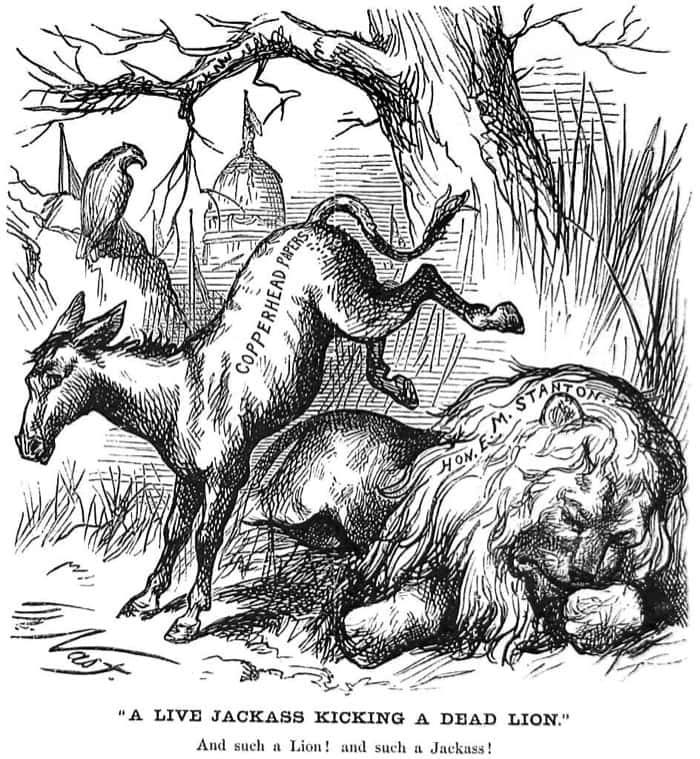
It all started with a cartoon. On January 15, 1870, Thomas Nast published an illustration in Harper's Weekly that would forever link the Democratic Party to one of the most recognizable animals in American politics: the donkey. His cartoon bore the title "A Live Jackass Kicking a Dead Lion," and it delivered a biting critique of the political climate of the era.
So what was Nast getting at? The "jackass" stood for the Democratic press, which Nast believed was unfairly targeting Edwin M. Stanton—President Abraham Lincoln's former secretary of war—even after Stanton had passed away. Stanton was no stranger to controversy, and Nast found the donkey to be the perfect vessel for his criticism: an animal known for being stubborn, hardworking, and sometimes downright obstinate, much like the Democratic opposition he sought to portray.
That single image proved remarkably sticky. As the Reconstruction era unfolded, Nast's cartoons became wildly popular, wielding enormous influence over public sentiment and permanently fastening the donkey to the Democratic brand.
Why the Donkey?
Nast may have made the association famous, but he didn't invent it. The link between Democrats and donkeys stretches back to Andrew Jackson's 1828 presidential campaign, when rivals hurled the word "jackass" at him as an insult. Rather than bristle at the name-calling, Jackson leaned into it, incorporating donkey imagery into his own campaign materials as a badge of resilience and populist grit.
What Nast did so brilliantly was breathe new life into this older connection and weave it deep into the fabric of political culture. His illustrations went beyond simple mockery of Democrats—they created a powerful visual language that made political commentary immediately understandable to everyday Americans.
As the decades passed, the donkey transcended its origins in satire. It came to embody core Democratic ideals: hard work, perseverance, and solidarity with ordinary people. Meanwhile, the Republican elephant—another symbol Nast helped popularize—appeared during the same period, establishing the iconic visual rivalry that continues to define American political identity.
These two animals have become virtually synonymous with their parties in modern politics. What began as pointed caricatures eventually evolved into symbols worn with pride by both Democrats and Republicans. When Thomas Nast put pen to paper on this day in 1870, he wasn't merely crafting a witty political jab—he was laying the groundwork for one of the most enduring acts of political branding in American history.