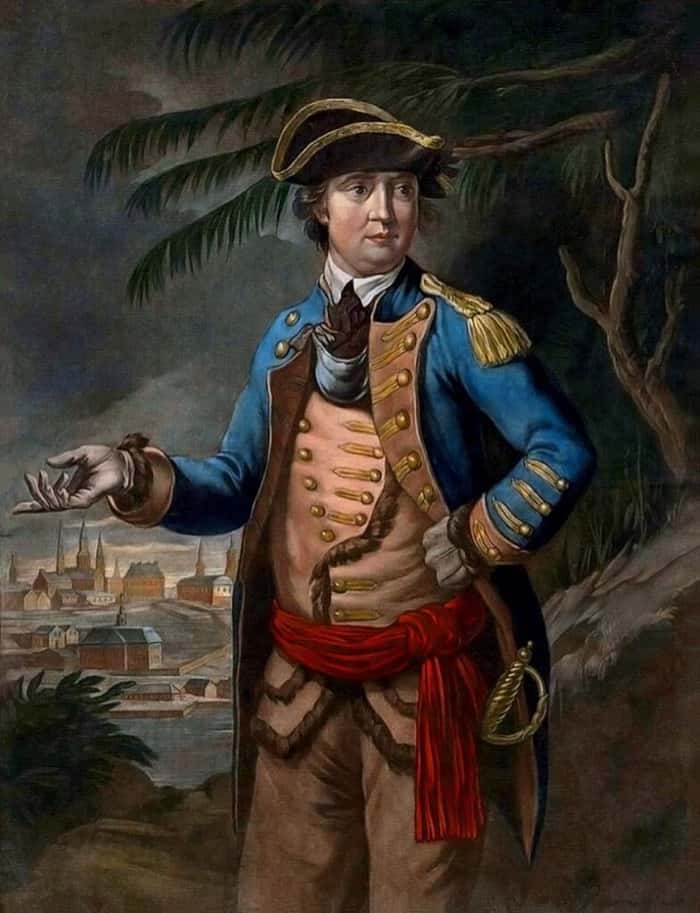
Born on this day in 1741, Benedict Arnold would become a figure defined by a striking duality — celebrated as a courageous general during the American Revolutionary War, then reviled as one of history's most infamous traitors. His early exploits on the battlefield won him widespread admiration, but his eventual betrayal sent shockwaves through the fledgling nation he had once fought to defend.
Strategically gifted and fearless in combat, Arnold distinguished himself early in the war, particularly at the Battle of Saratoga. Yet a toxic combination of financial difficulties, simmering resentment, and a feeling that his contributions went unrecognized pushed him toward conspiracy with the British. When his scheme to surrender West Point was exposed in 1780, the young nation breathed a collective sigh of relief — but Arnold managed to flee, forever cementing his reputation as the ultimate symbol of betrayal.
Fun Facts:
- Arnold's military leadership was pivotal in early Revolutionary battles. He was known for his daring exploits during the invasion of Canada and his critical role in the Battle of Saratoga.
- In 1780, Arnold plotted to hand over West Point to the British in exchange for money and a position in their army. The plot was uncovered, but Arnold escaped to British lines.
- In American history, Arnold's name has become virtually interchangeable with the word treachery — a powerful cautionary tale about what happens when ambition curdles into disloyalty. The impact of his actions on the trajectory of American history carries a weight that simply cannot be dismissed.
- A life defined by contradictions, Arnold was at once a fearless leader and brilliant strategist whose personal grievances and unchecked ambition drove him to turn against the very cause he had once championed. Following his defection, he spent the rest of his days in England, ultimately dying in relative obscurity in 1801.
- Even so, Arnold's early contributions to the American Revolution cannot be denied. His story stands as a powerful reminder of how complex human nature truly is, and how profoundly choices fueled by pride and resentment can shape a person's legacy.
- Arnold's scheme to betray West Point came dangerously close to succeeding. Had the plot gone undetected, it could have drastically changed the entire outcome of the Revolutionary War.