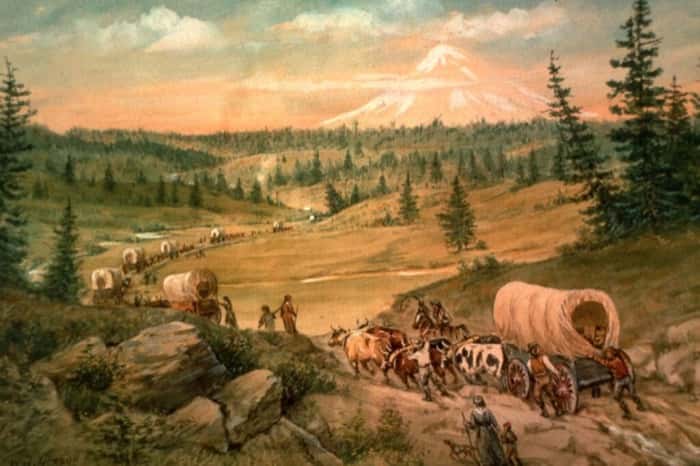
On May 22, 1843, a massive group of 1,000 people departed Independence, launching what would become known as the Great Emigration.
Picture this: 1,000 men, women, and children gathering in the town of Independence, Missouri, climbing into wagons, and setting off toward a future they could only imagine. Their goal? Finding abundant farmland they could claim as their own and the freedom to shape their lives however they saw fit. With that departure, the first wagon train bound for the Oregon Territory rolled forward, and the Great Emigration was truly underway.
Now, these weren't the very first pioneers to venture westward in pursuit of opportunity — but no group before them had matched their size or level of organization. The Oregon Territory, it's worth noting, had been home to Native Americans for tens of thousands of years. American missionaries and fur trappers had also established a presence there over the preceding few decades, and their reports about the remarkable agricultural promise of Oregonian land sparked widespread excitement back East. In 1841, a party of 70 pioneers had followed the path originally carved out by traders and missionaries. The following year, another 100 made the same journey.
That same trail became the road for the 1843 wagon train. What drove such a massive, well-coordinated effort? The western part of the country — the region we now call the Midwest — was mired in a brutal economic depression. Faced with bleak prospects, many people became convinced that their best shot at building a prosperous life meant leaving the country altogether and carving out an existence in the "unowned" territories lying to the west.
Crossing the Great Plains proved to be the easier stretch of the journey. Each night, the train — roughly 100 wagons in all — arranged itself into a circle, corralling horses, cattle, and oxen safely inside. By day, progress was slow, the caravan covering less distance than a healthy adult could manage on foot. Then came the Rocky Mountains, and everything got harder. Some passes were simply too steep for the wagons, sending them toppling over or breaking loose to careen uncontrollably downhill. Despite these harrowing challenges, the vast majority of pioneers made it through and reached the fertile lands of the Oregon Territory later that year.