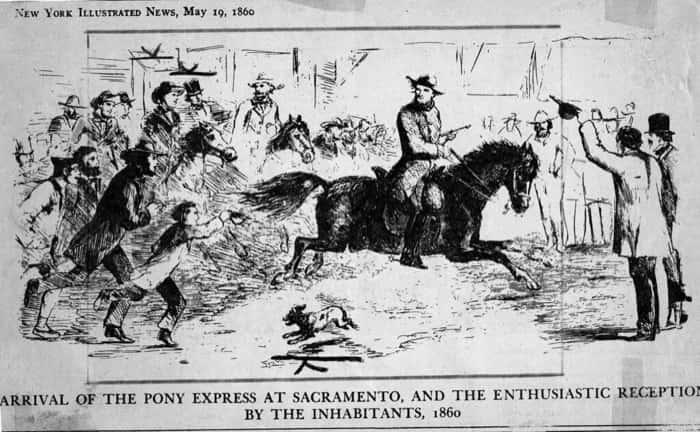
Sacramento, California received its very first Pony Express mail delivery on April 13, 1860, capping off a journey that had taken ten days. Serving as a horseback mail delivery system across the United States, the Pony Express is a name almost everyone recognizes — yet the service itself was remarkably brief. Running only from April 3, 1860 to October 26, 1861, riders carried mail on horseback across enormous stretches of terrain between Missouri and California at impressive speeds. The Express managed to cut roughly ten days off previous delivery times.
This dramatic improvement in efficiency quickly made the Pony Express the go-to method for communication between the East and West during its 18 months of operation. California, in particular, benefited enormously from the service, as the state was in the process of being newly incorporated into the broader United States at that time. The role the Pony Express played in facilitating communication proved essential to making that integration work.
For all its contributions, however, the venture was a financial failure. After just a year and a half of operation, the service went bankrupt. Its collapse happened to align with the widespread adoption of the transcontinental telegraph, a technology that enabled far swifter communication.
Even so, the Pony Express has carved out a distinctive niche in American history and culture. Its lifespan may have been short, but romanticization of the service began almost immediately after it ceased operations. Over the longer term, it wove itself into the fabric of the archetypal American West. This enduring mystique is believed to be rooted in the rugged individualism that the service and its riders came to embody — a brand of individualism that remains distinctly American, both historically and in the modern era.