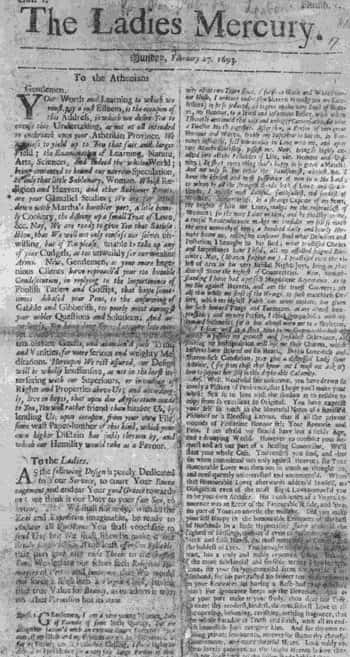
When The Ladies' Mercury rolled off the presses on February 27, 1693, it carved out a unique place in publishing history. Never before had an English periodical been created with women as its sole intended audience. Brought to life in London under the banner of the Athenian Society, this pioneering yet fleeting publication reflected a growing acknowledgment that women represented a powerful and distinct force in the world of print media.
The mind behind this venture was John Dunton, a London publisher who had already made a name for himself with The Athenian Mercury. That periodical had built a loyal following by inviting readers to submit questions on wide-ranging subjects — from science and religion to deeply personal dilemmas — and publishing thoughtful responses. As Dunton observed a steadily expanding female readership, he began weaving in a dedicated section that spoke directly to women's concerns: love, marriage, and the rhythms of domestic life. These features proved so popular that they inspired an entirely separate publication — The Ladies' Mercury — crafted from the ground up with women in mind.
Physically, each issue consisted of a double-sided sheet built around an advice column that tackled questions sent in by readers. Its mission statement was ambitious, pledging to explore "all the nicest and curious questions concerning love, marriage, behavior, dress, and humor of the female sex, whether virgins, wives, or widows." Structured as an ongoing conversation, it opened a rare door for women to seek counsel on personal and social matters during a period when their perspectives were routinely sidelined.
For all its forward-thinking spirit, The Ladies' Mercury proved remarkably short-lived, spanning just four issues before its final edition appeared on March 17, 1693. Why it ended so abruptly remains something of a mystery. One theory holds that it threatened to siphon female readers away from The Athenian Mercury, prompting Dunton to pull the plug. Others have argued that its brevity belies its true significance — that its influence stretched well beyond those few printed sheets.
Legacy
At a time when the printed word was overwhelmingly shaped by male voices, The Ladies' Mercury represented a daring acknowledgment that women had their own concerns, curiosities, and intellectual interests worthy of dedicated attention. It opened a channel through which women could begin to make themselves heard. The trail it blazed would be followed by later publications like The Female Tatler and The Female Spectator, which built on its foundation and further cemented women's roles as active voices in the literary and cultural conversations of their day.