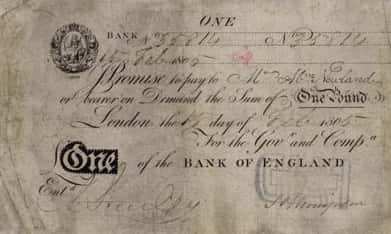
On February 26, 1797, something happened that would forever reshape British finance: the Bank of England put its first-ever £1 note into circulation. Born out of the extraordinary pressures of the time, this modest piece of paper represented a pivotal turning point in the story of British currency.
Britain's economy was buckling under the weight of the French Revolutionary Wars during the late 18th century, and gold bullion had become dangerously scarce. Faced with this mounting crisis, the Bank of England responded with striking resourcefulness — it began producing banknotes in smaller denominations, with the revolutionary £1 note chief among them.
What's fascinating is just how different these early notes were from the uniform, mass-produced currency familiar to us today. Every single £1 note was handwritten by hand. Printed on only one side, each note bore the payee's name, the date, and the signature of the issuing cashier. Because of the ongoing gold shortage, holders of these notes had no ability to redeem them for gold from 1797 through 1821 — a lengthy span that became known as the "Restriction Period." Once the Napoleonic Wars drew to a close, Britain returned to the gold standard, making it possible once again to convert notes into their gold equivalent. The £1 note itself, however, was pulled from circulation in 1821, with gold sovereigns stepping in as its replacement.
Legacy of the £1 Note
Though it existed for only a relatively short window, the £1 note carved out a lasting place in British monetary history. In the midst of a severe crisis, it demonstrated just how adaptable and resilient paper money could be. As the centuries passed, the note saw multiple redesigns and revivals — notably during World Wars I and II — rising to meet fresh challenges each time Britain needed it most.
By modern standards, that original £1 note may appear humble and unassuming. Yet its creation was genuinely revolutionary — a testament to innovation forged under duress. It established the foundation for the currency systems that still serve us today, and it continues to stand as a reminder that times of crisis can spark the most creative thinking for generations to come.