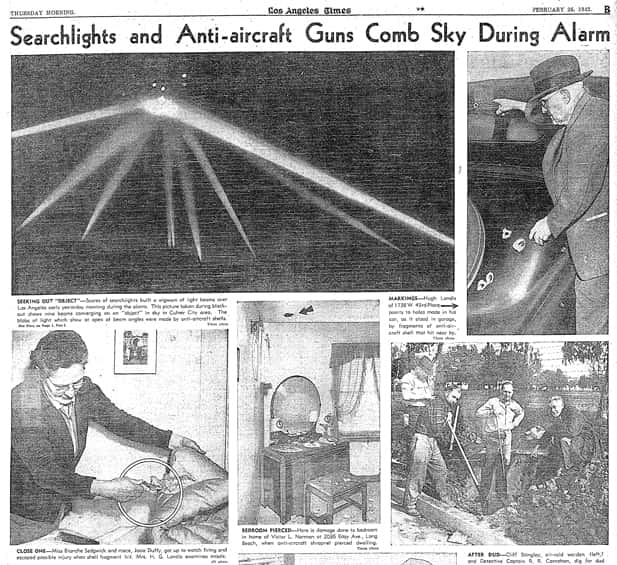
Picture this: it's the dead of night on February 24, 1942, and the city of Los Angeles has erupted into chaos. Searchlights are slicing through the darkness, anti-aircraft batteries are thundering away, and terrified residents across the city are convinced an enemy assault is underway. Yet once the dust settled and dawn broke, there was nothing to show for it—no downed aircraft, no wreckage, not a single trace of an enemy presence. So what exactly triggered the notorious "Battle of Los Angeles"? Was it a genuine military threat, a city gripped by collective hysteria, or perhaps something far stranger?
The United States was still reeling from Pearl Harbor, and anxiety along the West Coast had reached a fever pitch. When air raid sirens suddenly wailed across Los Angeles on February 24, 1942, the immediate assumption for many was the one they dreaded most—a Japanese attack on American soil. Over the course of several hours, anti-aircraft batteries unleashed more than 1,400 rounds skyward. Eyewitnesses described seeing unidentified flying objects, mysterious lights, and bizarre shapes hovering above. And yet, not a single enemy plane was ever recovered or confirmed. The U.S. military would eventually chalk the whole episode up to a false alarm—likely triggered by a weather balloon or simply war-time paranoia. It's worth noting that conditions that night included low clouds and a full moon, a combination that could have easily played tricks on the eyes of anti-aircraft gunners, causing them to misidentify the weather balloon as a hostile aircraft.
For decades afterward, the incident fueled wild speculation and debate. Was this simply mass hysteria taking hold of a frightened population? An early UFO encounter? Or was there something the government chose to keep hidden from the public? To this day, the "Battle of Los Angeles" stands as one of the most perplexing and unexplained episodes in American history, its mystery stubbornly refusing to fade with time.
Fun Facts:
- The Battle of Los Angeles is also called the Great Los Angeles Air Raid.
- Most American Citizens were on edge after the recent surprise Pearl Harbor attack on December 7, 1941, that left 2,400 Americans dead and countless injured. This devastating event had a profound impact on the nation's psyche, leading to heightened fear and suspicion of potential enemy attacks.
- This attack came just a day after the bombardment of Ellwood near Santa Barbara. The Ellwood oil field, a significant source of oil for the war effort, was shelled by a Japanese submarine, further fueling the fear of a potential invasion on the U.S. West Coast.
- Speaking to the public shortly after, the secretary of the Navy, Frank Knox, called the alleged attack a false alarm.