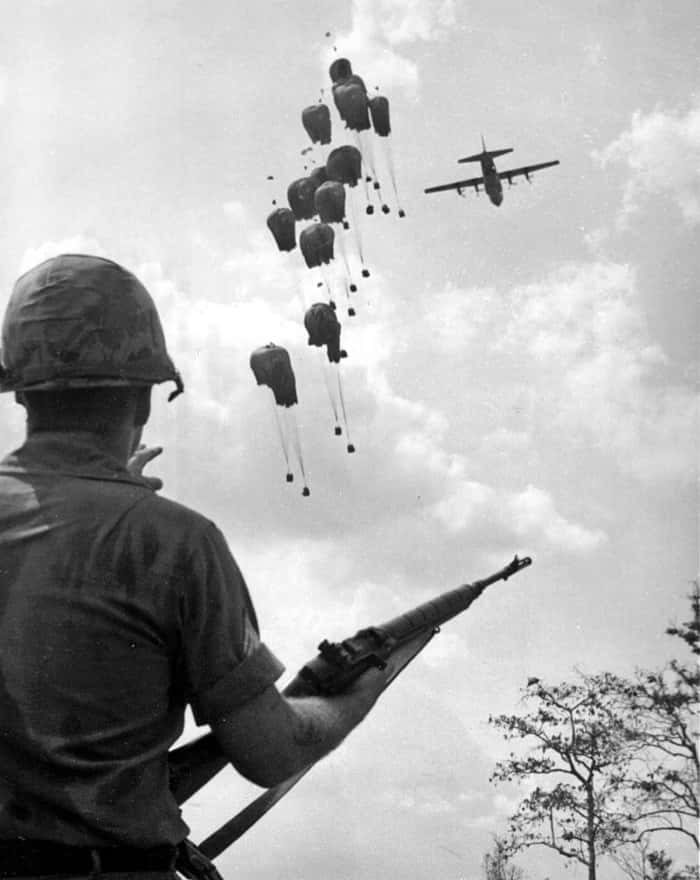
When Operation Junction City kicked off on February 22, 1967, it launched what would become one of the Vietnam War's most ambitious and large-scale U.S. military undertakings. The central objective was clear: penetrate Tay Ninh Province in South Vietnam, dismantle Viet Cong strongholds, and throw a wrench into their operations. Over the course of 82 days, this sprawling offensive would lay bare both the enormous scope and the deep complexity of the war itself.
More than 25,000 U.S. and South Vietnamese troops deployed into Tay Ninh Province, an area situated close to the Cambodian border. The operation's opening move was nothing short of dramatic — an airborne assault featuring nearly 250 helicopters, the biggest such operation since World War II. Once the airborne phase set the stage, ground forces pushed through the region, hunting for Viet Cong bases, supply routes, and tunnel systems. Yet for all its sheer size and firepower, the operation ran headlong into the realities of guerrilla warfare. The Viet Cong exploited the thick jungle terrain masterfully, turning the landscape itself into a weapon against the advancing forces.
By the time the operation wrapped up on May 14, 1967, after 82 grueling days of combat, the results painted a complicated picture. U.S. and allied forces had dealt heavy losses to the Viet Cong and exposed vast tunnel networks — real, tangible achievements. But the overarching mission of capturing the COSVN leadership slipped through their grasp, leaving a legacy that was decidedly mixed in strategic terms. Even so, the operation's broader strategic importance remains hard to overstate.
Fun Facts:
- Operation Junction City drew its name from Junction City, Kansas, where Fort Riley is located — a training ground for some of the troops involved.
- The initial assault employed nearly 250 helicopters, cementing it as one of military history's largest helicopter-based operations.
- The operation uncovered the 'Iron Triangle,' a key Viet Cong stronghold. The 'Iron Triangle' was a heavily fortified area that served as a significant Viet Cong base, housing their headquarters and extensive tunnel networks. Its discovery was a significant blow to the Viet Cong's operations.
- Even with its enormous scale, the offensive delivered limited results since the COSVN headquarters were never located.
- The elaborate tunnel networks employed by the Viet Cong stood as a testament to their resourcefulness in neutralizing the advantages of superior firepower.