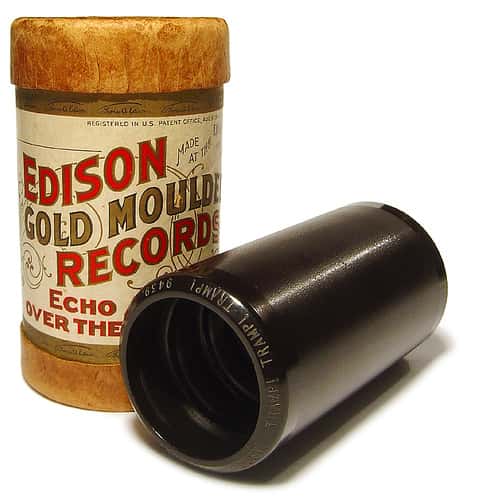
On February 19, 1878, Thomas Edison received U.S. Patent No. 200521 for an invention that would fundamentally alter the course of audio technology: the Cylinder Phonograph. For the first time in human history, a device existed that could both record sound and play it back.
Edison's Revolutionary Invention
While working on improvements to the telegraph and telephone in 1877, Thomas Edison stumbled upon the foundational concept behind the phonograph almost by accident. He realized that sound vibrations could be translated into physical indentations etched onto a tinfoil-wrapped rotating cylinder — and that a stylus could trace those grooves to reproduce the original audio. The moment he unveiled a working prototype in December 1877, listeners were stunned. Hearing a recorded human voice played back before their ears was nothing short of extraordinary, and audiences couldn't get enough of it.
Impact on Sound Recording
At first, many dismissed the phonograph as little more than a novelty. That perception shifted, however, once people recognized its potential to store music, capture business orders, and preserve the spoken word. Edison himself imagined three core applications for his creation: education, telecommunication, and historical sound production. What followed was nothing less than an entertainment revolution — one that fundamentally reshaped how audiences engaged with music and audio recordings. The device didn't just change listening habits; it laid the foundation for the entire modern entertainment industry.
Over time, the original tinfoil phonographs gave way to wax cylinders, and developers eventually introduced flat disc records, which went on to become the industry standard. Edison's pioneering work left a lasting imprint on audio technology, forever transforming how people experienced music, captured speech, and safeguarded sounds for generations to come.
Did You Know?
- Edison originally envisioned the phonograph as a tool for business dictation rather than entertainment.
- The first recording he made on the phonograph was "Mary Had a Little Lamb."
- Early phonograph cylinders were coated in tin foil, which wore out quickly. This led to the development of wax cylinders, a more durable and long-lasting material. The transition from tinfoil to wax significantly improved the phonograph's design and usability.
- In the late 1800s, coin-operated phonographs were placed in public spaces, allowing people to listen to recordings for a fee.