Born on February 13, 1891, on a farm near Anamosa, Iowa, Grant DeVolson Wood would go on to become one of the most prominent voices in the Regionalist art movement — a movement dedicated to capturing the spirit and texture of rural American life during the early 20th century.
When Wood's father passed away in 1901, the family relocated to Cedar Rapids, Iowa, and it was in this new setting that his artistic passion truly took root. He studied at Washington High School before enrolling at the Minneapolis School of Design and Handicraft in 1910. Driven by an unwavering commitment to his craft, he then made his way to the School of the Art Institute of Chicago, where he spent the years from 1913 to 1916 rigorously developing his abilities across a range of artistic disciplines.
Wood made several trips to Europe between 1920 and 1928, soaking up a variety of artistic traditions along the way. He dabbled in Impressionism and Post-Impressionism, but it was the painstaking detail found in the work of 15th-century Flemish painters that truly captivated him. Jan van Eyck became a particular favorite, and the Dutch master's influence left a lasting mark on Wood's technique. You can see this clearly in the sharp clarity and exacting precision that define his later paintings.
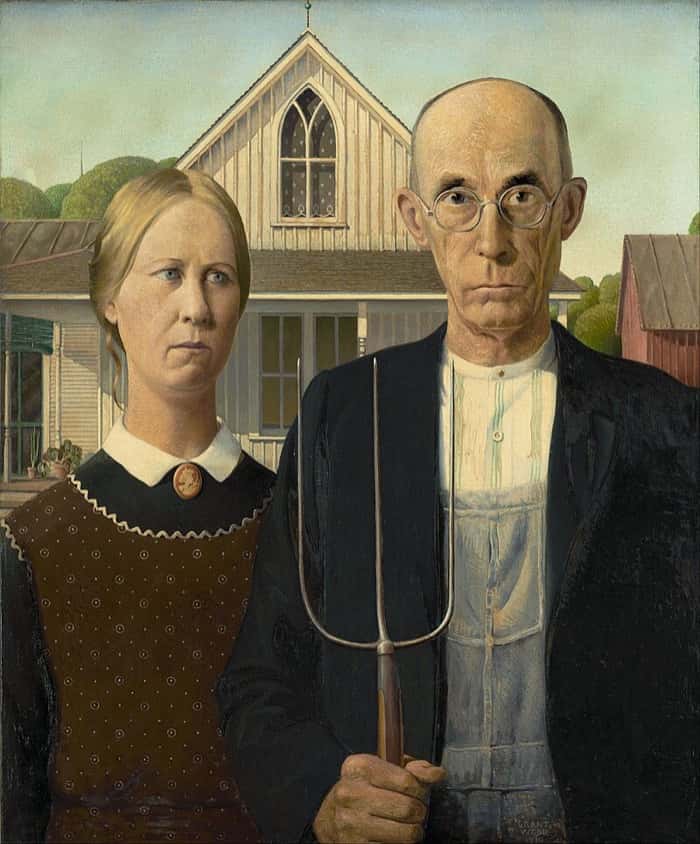
'American Gothic,' completed in 1930, would become Wood's most enduring achievement. Depicting a stern-faced farmer alongside his daughter, standing before a modest farmhouse, the painting quickly emerged as the defining image of the Regionalist movement. Its realistic portrayal of rural American life resonated deeply with viewers, while the intricate detail and unflinching Midwestern stoicism it conveyed struck a powerful chord with audiences across the country. The work demonstrated art's remarkable ability to reflect society back to itself, cementing Wood's reputation on both a national and global stage.
Legacy
Beyond 'American Gothic,' Wood continued producing notable works that celebrated Midwestern themes, among them "The Midnight Ride of Paul Revere" (1931) and "Daughters of Revolution" (1932). He was also instrumental in founding the Stone City Art Colony in 1932, creating a vital creative community for artists weathering the hardships of the Great Depression.
Wood accepted a faculty position at the University of Iowa in 1934, where he taught painting up until pancreatic cancer claimed his life on February 12, 1942 — heartbreakingly, just one day shy of his 51st birthday. To this day, "American Gothic" stands as one of the most instantly recognizable works of art in the United States.