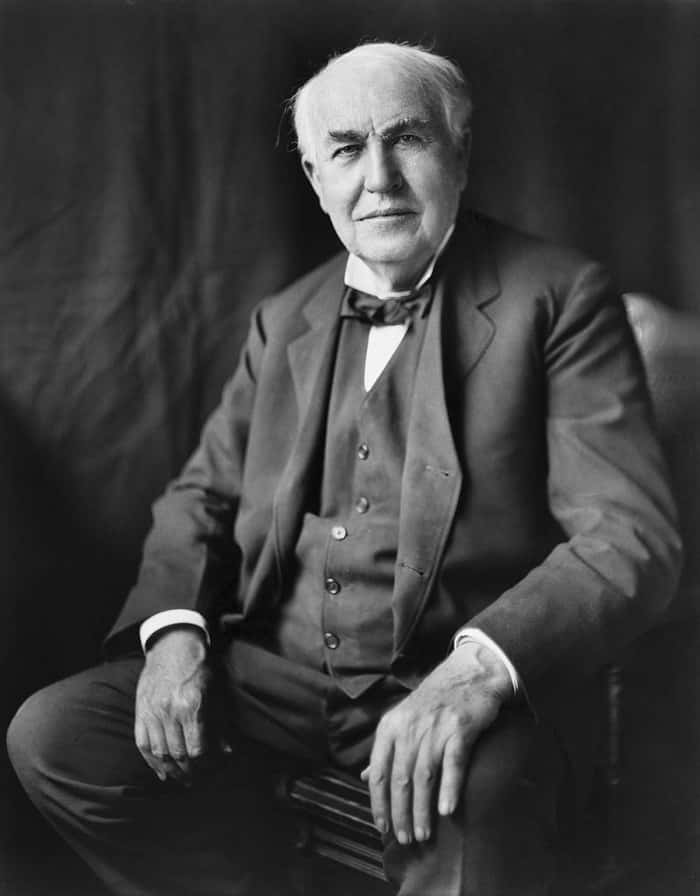
Few figures in American history cast as long a shadow as Thomas Alva Edison, who came into the world on February 11, 1847, in Milan, Ohio. His formative years were spent in Port Huron, Michigan, where he was raised alongside six older siblings. Rather than attending traditional schools, Edison received most of his education at home under his mother's guidance. When he was just 13, he took a job hawking newspapers on a railroad line — and it was there that the telegraph captured his imagination, igniting a passion for technological innovation that would define his entire life.
By 16, Edison had committed himself fully to working as a telegraph operator. During this period, a fellow inventor and colleague named Franklin Leonard Pope took the young Edison under his wing, going so far as to offer him a place to live and work in his basement. Telegraphy proved to be fertile ground for Edison's inventive mind, inspiring early creations like the stock ticker. He secured his very first patent — for the electric vote recorder — at the age of 22.
Edison took a transformative leap in 1876 when he moved his laboratory to Menlo Park, New Jersey, and built what is recognized as the world's first research and development facility. He called it his 'invention factory,' and the concept was groundbreaking: assembling talented minds under one roof to collaborate on projects from initial idea through finished product. The model Edison created at Menlo Park proved enormously influential, inspiring future industrial laboratories — including Bell Laboratories — to adopt a similar approach to innovation.
Though Edison is most celebrated for inventing the light bulb, his genius extended to making that technology commercially practical. He constructed the first commercial power station in New York City in 1882, single-handedly ushering in the electric age. Over the course of his career, he amassed an astonishing 1,093 patents, with the phonograph, motion picture camera, and storage battery ranking among his most famous contributions. Beyond the lab, Edison proved himself a savvy businessman as well, launching 14 companies — one of which eventually evolved into General Electric. To this day, he is regarded as the most prolific and influential inventor in American history.