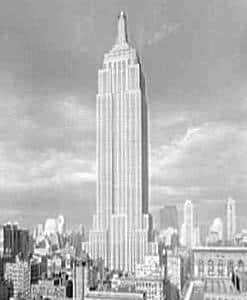
When the Empire State Building threw open its doors for the first time on May 1, 1931, the occasion was marked with considerable fanfare. President Hoover himself participated in the dedication from afar, pressing a specially installed button at the White House that was meant to illuminate the skyscraper's lights for the very first time.
Of course, the reality behind the spectacle was a bit less magical than it appeared. That button was purely symbolic — it didn't actually control anything. When the moment arrived, a worker inside the Empire State Building simply flipped a switch to bring the lights to life. But none of that diminished the grandeur of the occasion. After all, this was the tallest building on the planet, soaring to 1,454 feet across 102 stories. Its striking art deco design drew widespread admiration, and to this day, it remains one of the most recognizable skyscrapers anywhere in the world — even though it long ago lost its claim as the tallest.
What many people don't realize is that the Empire State Building grew out of an intense rivalry between two of the era's most powerful business titans. Walter Chrysler, who led the Chrysler Corporation, was determined to construct the world's tallest building. So was John Jacob Raskob, a top executive at the General Motors Corporation. The two were locked in a race to claim that title. Chrysler actually crossed the finish line first — his Chrysler Building briefly held the record as the world's tallest at 1,046 feet.
For over fifty years, the Empire State Building was visible from nearly anywhere in New York. That's no longer the case, unfortunately. A proliferation of taller — and far less interesting — buildings has gradually blocked it from view across much of the city. Remarkably, you can't even catch a glimpse of it from certain stretches of the very street where it stands. The vista from atop the Empire State Building itself, however? That remains absolutely breathtaking.