Throughout the nineteenth century, as America pushed its boundaries westward, settlers laid claim to territories in the west under the authority of American law. Naturally, the Native Americans already living on those lands pushed back against this encroachment. Rather than engaging in direct warfare with the Plains tribes, the U.S. government relied on stalling strategies. Treaty after treaty was signed with these tribes—only to be broken—effectively undermining any chance for the Plains tribes to mount a strong, unified resistance.
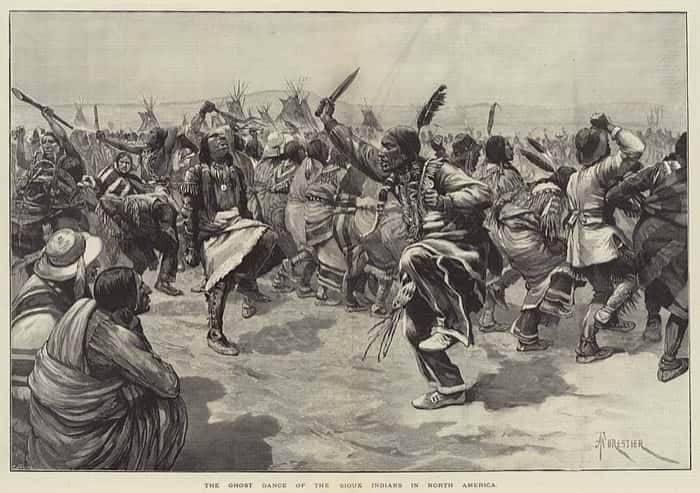
Over time, the tribes found themselves confined to reservations under U.S. government control. Life on these reservations came with strict demands: Native Americans had to adopt American styles of speech and dress and convert to Christianity. With farming conditions being poor, many had little choice but to depend heavily on rations distributed by the government. Amid these oppressive circumstances, a centuries-old ceremony called the Ghost Dance began spreading widely across the reservations as a form of spiritual resilience.
The Ghost Dance was, by and large, a peaceful tradition. Yet certain U.S. officials saw it as evidence of a militant movement bent on destroying the United States. A military crackdown on the practice followed, sparking a resistance movement within the reservations under the leadership of Lakota chief Sitting Bull. When the U.S. military attempted to arrest him, the confrontation turned deadly—Sitting Bull and several others were shot. In the wake of this violence, many men across the reservations united, bracing themselves against what they saw as an imminent U.S. attack.
By the time the U.S. 7th Cavalry reached Wounded Knee Creek, tensions had already reached a breaking point. Soldiers conducted weapons searches that were perceived as highly intrusive, prompting a Ghost Dance to be performed in protest. What followed was devastating: U.S. soldiers fired indiscriminately into the crowd, cutting down Native American fighters along with groups of women and children. The death toll exceeded 200 people, and with this horrific event, both the Ghost Dance movement and organized resistance to the U.S. government were effectively brought to an end.