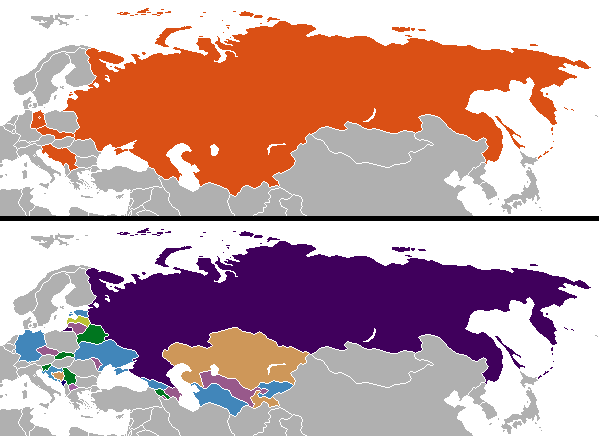
The end of the Soviet Union, finalized on December 21, 1991, brought the curtain down on a superpower that had shaped global politics for the better part of the 20th century. On that day, eleven former Soviet republics put their signatures on the Alma-Ata Protocol, a landmark agreement that formally confirmed the USSR's disbanding while recognizing the independence of its member states. This watershed moment didn't happen overnight — it came after years of mounting political and economic turmoil that had steadily eroded the foundations of the Soviet regime.
Fun Facts:
- The Alma-Ata Protocol, signed by representatives of 11 Soviet republics, served a dual purpose: it officially brought the Soviet Union to a close and simultaneously gave birth to the Commonwealth of Independent States (CIS).
- Gorbachev, the USSR's final leader, set in motion reforms known as glasnost (openness) and perestroika (restructuring) — changes that, ironically enough, ended up hastening the very collapse of the union he sought to modernize.
- Gorbachev's Resignation: Just days after the signing of the Alma-Ata Protocol, Mikhail Gorbachev stepped down as President of the Soviet Union, making his official resignation on December 25, 1991.
- In the wake of the dissolution, 15 independent countries emerged onto the world stage, among them Russia, Ukraine, Belarus, and the Baltic States of Estonia, Latvia, and Lithuania.
- Decades of bitter rivalry and tension between the USSR and the United States came to a definitive end with the Soviet Union's collapse.
- When Christmas Day arrived, the iconic Soviet flag was lowered from the Kremlin one final time, and in its place rose the Russian tricolor — a powerful visual symbol of a new era.
- A Nuclear Legacy: Global security anxieties spiked as the newly independent states found themselves inheriting thousands of nuclear weapons from the former superpower.
- The Baltic States Led the Way: Estonia, Latvia, and Lithuania blazed the trail by being among the first republics to declare independence, setting off a wave of inspiration that emboldened other republics to follow suit.
- Name Change for Russia: In the aftermath of the dissolution, Russia took on a new official identity, becoming the Russian Federation.