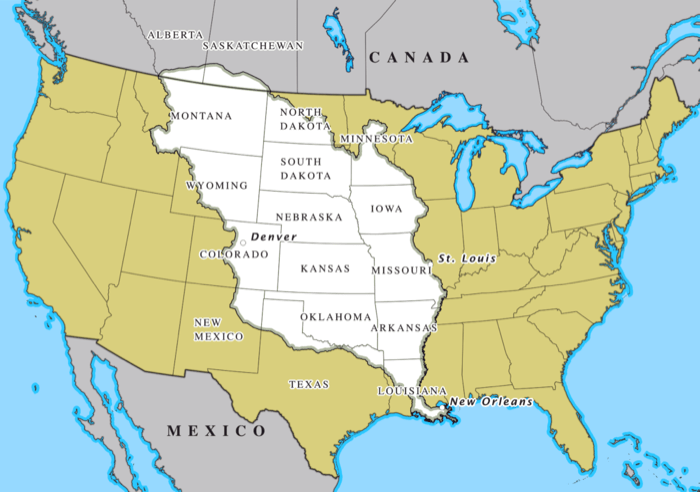
On December 20, 1803, one of the most consequential real estate transactions in human history reached its dramatic conclusion in New Orleans. As the French flag came down and the United States officially took possession of the Louisiana Territory, the young republic instantly doubled in size. Known as the Louisiana Purchase, this $15 million deal with France didn't just redraw the map—it fundamentally transformed the trajectory of American history, unlocking new frontiers and creating vast new possibilities for the nation.
Few moments in the story of the United States carry as much weight as the Louisiana Purchase. Here's a closer look at what happened and why it still resonates:
- Talk about a bargain for the ages—France parted with 828,000 square miles of territory for just $15 million, which works out to a mere 4 cents per acre.
- Spanning from the Mississippi River all the way to the Rocky Mountains, this massive acquisition effectively doubled the land area of the United States.
- From an economic and strategic standpoint, the deal was a no-brainer for the United States. It delivered rich agricultural lands, locked down vital trade routes, and flung open the door to westward expansion.
- Jefferson's Vision: Despite lingering questions about whether the move was constitutionally permissible, President Thomas Jefferson pushed hard for the purchase, viewing it as essential to the nation's long-term growth and expanding influence.
Fun Facts:
- Why did France let go of such an enormous territory? Napoleon Bonaparte needed the funds to bankroll his military campaigns across Europe and wanted to concentrate his efforts closer to home.
- The formal transfer of sovereignty played out on December 20, when French officials ceremoniously lowered their flag in Jackson Square and hoisted the Stars and Stripes in its place.
- The territory that changed hands would eventually become 15 future states, including present-day Arkansas, Missouri, Iowa, Minnesota, and more.
- Impact on Indigenous Peoples: For many Native American tribes, the purchase had devastating consequences, as waves of settlers pushed westward into these newly claimed territories and displaced Indigenous communities.
- Setting the Stage for Exploration: Soon after the deal was finalized, the celebrated Lewis and Clark Expedition set out to map and explore the sprawling new lands that now belonged to the United States.