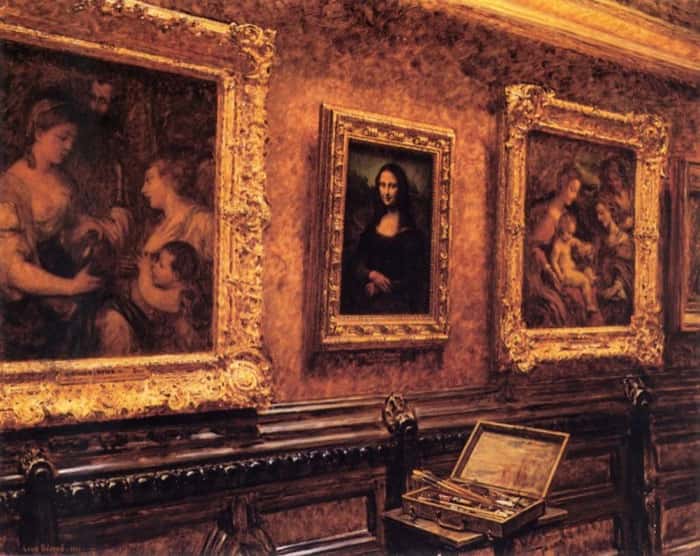
What makes something priceless? Sometimes, it takes losing it to find out. The Mona Lisa stands today as perhaps the most recognized painting on the planet. Before 1911, however, it languished in relative obscurity, familiar mainly to scholars and art connoisseurs. Its meteoric rise to fame had little to do with that mysterious smile — instead, it was a brazen theft from the Louvre in 1911 that thrust the painting into the worldwide consciousness.
When a piece vanishes from the Louvre — a world-famous museum housing a collection beyond replacement — people take notice. News of the stolen Mona Lisa spread like wildfire, with newspapers running story after story and reproductions of the painting appearing everywhere the public could see them. Making matters even more captivating, the investigation seemed to go nowhere for an extended period, which only deepened the mystery and kept the world riveted.
Ultimately, though, the trail led authorities to Vincenzo Peruggia, an Italian waiter who had been residing in Florence, Italy. Getting to that point was no simple matter — the investigation was grueling, riddled with dead ends and misleading clues. But on December 11, 1913, the painting was found inside Peruggia's room.
As it turned out, Peruggia was no stranger to the Louvre — he had previously worked there. His job, ironically enough, had been constructing protective glass cases for the Mona Lisa and other works of art. His method was almost laughably simple: one night, rather than leaving after his shift, he concealed himself in a closet. He then took the painting, tucked it beneath his smock, and strolled right out of the building — his only hiccup being a door that was unexpectedly locked, which caused a brief delay. Astonishingly, the theft went undetected for days because staff initially assumed the painting had simply been taken away for cleaning.
Authorities in Paris had actually dismissed Peruggia as a suspect early on, focusing their suspicions instead on the artist Pablo Picasso. It was Italian police who ultimately uncovered his role after he reached out to them regarding the painting. His motive, it turned out, was rooted in nationalism — he had apparently stolen the Mona Lisa with the intention of returning it to what he considered its rightful home of Florence, Italy, a feeling stoked by the nationalist passions of the era. Far from receiving the hero's welcome he anticipated, Peruggia found himself in handcuffs instead. The world quickly moved on from the thief himself, but the painting he stole? That, nobody ever forgot.