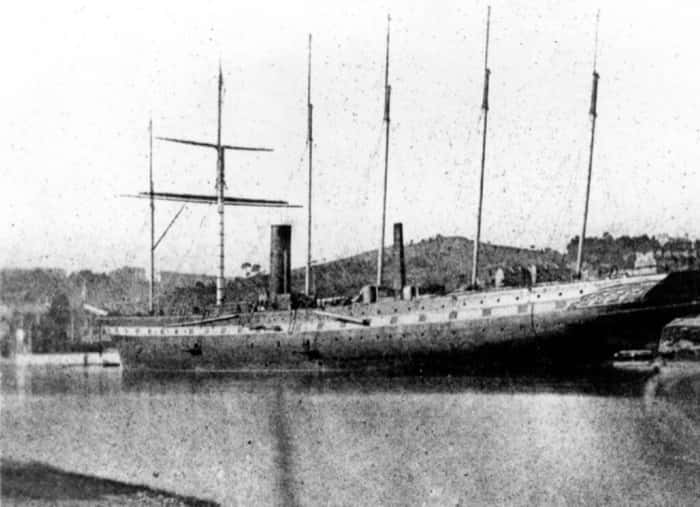
On March 19, 1863, the steamship SS Georgiana met its end at the bottom of the sea — never having fired a single shot in battle. Built in Scotland in 1862 for the Confederate States Navy during the American Civil War, the vessel was designed to be a formidable warship. Its intended armament included sixteen mounted guns, and it was expected to haul upwards of 400 tonnes of cargo. Yet when the SS Georgiana embarked on its maiden voyage bound for Charleston, South Carolina, it sailed without any of that artillery — a fateful detail that would soon prove disastrous.
Trouble found the SS Georgiana as it approached Charleston. The crew tried to evade a Federal Blockading Squadron operating nearby, but their efforts were thwarted when a racing yacht in the vicinity spotted the steamer. The yacht quickly deployed signal flares, summoning the rest of the squadron's fleet to the scene. Hopelessly outnumbered and lacking any real firepower, the Confederate crew faced an impossible situation. With no viable means of escape, the captain made the drastic decision to scuttle the ship — deliberately sinking and burning it so that neither the vessel nor its crew would fall into enemy hands.
More than a century later, in 1965, underwater archaeologist E. Lee Spence located the wreck of the SS Georgiana resting in Charleston's harbor. The find carries considerable historical and archaeological weight. From a historical standpoint, the ship played a notable role in the Civil War narrative. Archaeologically, the site is especially remarkable because it contains the hulls of not one but two sunken vessels: the SS Georgiana and the SS Mary Bowers. Despite having been constructed within only two or so years of each other, the two ships are distinctly different in design — a circumstance that provides underwater archaeologists like Spence with a rich trove of comparative data.