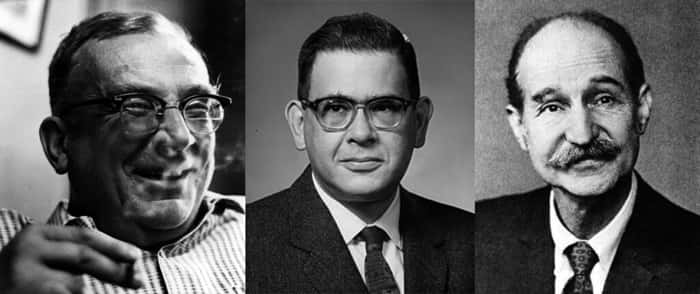
It was on April 1, 1952, that Ralph Alpher, George Gamow, and Hans Bethe put forward what would become known as the Big Bang Theory, laying out their ideas in a paper that appeared in the scientific journal Physical Review. Officially titled "The Origin of Chemical Elements," the landmark work quickly earned a more memorable nickname: the Alpher–Bethe–Gamow paper, often abbreviated playfully as αβγ.
So what exactly is the Big Bang Theory? In short, it's the widely accepted cosmological framework explaining how the observable universe came into being. Scientists have found multiple lines of evidence supporting this model, and the very first of these was introduced in the pioneering Alpher–Bethe–Gamow paper.
What the paper showed was how the Big Bang model could explain the observable abundance and relative proportions of elements found throughout the universe — including hydrogen, helium, and heavier elements. It's worth noting that the original work didn't account for every mechanism behind the formation of heavier elements, such as stellar nucleosynthesis (the process by which nuclear fusion inside stars generates new elements). Nonetheless, it blazed a trail for fellow astrophysicists and researchers to delve deeper into Big Bang nucleosynthesis — the process through which elements were forged during the universe's earliest moments.
When we look at the observable universe, the overwhelming majority of ordinary matter — known as baryonic matter — consists of hydrogen and helium, the two elements containing the fewest protons and neutrons. One of the Big Bang Theory's greatest strengths is its ability to accurately predict the measurable abundance and proportions of these elements, matching what scientists actually observe today.