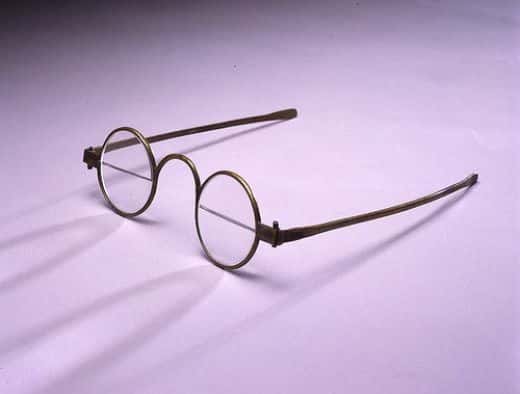
Ever had trouble seeing things far away? Or maybe it's the close-up stuff that gets blurry? For countless people, one of these issues creeps in with age. It's no wonder that the invention of glasses during the fifteenth century was such a game-changer.
Glasses designed one way could help long-sighted individuals get a clearer view of nearby objects. Built differently, they could sharpen distant images for short-sighted wearers. But what about those unlucky enough to struggle with both problems? For centuries, these individuals were stuck with the maddening hassle of juggling two separate pairs of glasses depending on what they needed to see. That all changed when Benjamin Franklin stepped in and transformed their daily experience.
Throughout his entire life, Franklin dealt with poor eyesight — and it only deteriorated with age. Benjamin Franklin had difficulty seeing distant objects, and close-up vision gave him even more trouble. While he wore glasses, the constant back-and-forth of swapping between pairs drove him crazy. Being the prolific inventor he was, he resolved to find a solution. On May 23, 1785, he came up with a clever design: glasses featuring two lenses stacked one above the other within each frame opening. The top lens gave the wearer clear distance vision, while the bottom lens brought nearby objects into focus. All you needed to do was shift your gaze slightly upward or downward to adjust what you could see clearly.
Admittedly, the original design had its drawbacks. Where the two lenses met, a visible line cut across the wearer's field of vision. On top of that, early versions were prone to having one or both lenses pop out, since securing two separate pieces of glass within a single frame proved quite challenging. Even so, Franklin and plenty of other users considered it a vast improvement over the alternative. And naturally, as technology advanced, so did the design.
Modern progressive bifocals use a single lens with a gradually changing thickness, allowing wearers to transition from near to far vision without any interruption — and without that telltale line across their glasses. Bifocal sunglasses and diving goggles are now available too. There are even bifocal contact lenses designed to be worn for a month at a time.