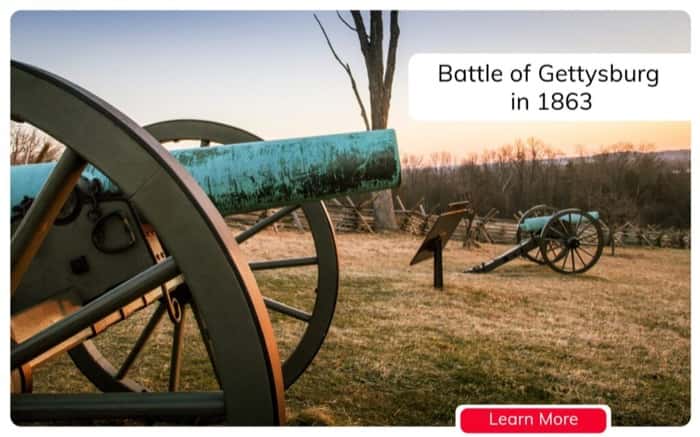
The Battle of Gettysburg, which raged from July 1 through July 3, 1863, stands as what many regard as the most significant engagement of the entire American Civil War. When the smoke cleared, it was the Union troops who emerged victorious.
Everything kicked off on July 1, when the Confederate Army pushed into Northern Virginia under the command of Gen. Robert E Lee. Fresh off a triumph over the Union Army at Chancellorsville, Lee felt emboldened to carry his campaign deeper into northern territory. His Confederate forces marched toward Gettysburg in pursuit of supplies, only to discover that Federal soldiers had already fortified their defensive positions throughout the town.
The fighting on July 2 arguably produced the most devastating bloodshed of the entire battle. Union forces had dug in along a defensive line stretching from Culp's Hill to Cemetery Ridge. Even though Gen. George G Meade's Union army clearly held the town, Lee stubbornly insisted on launching an assault against the northern contingent under Daniel Sickles — ignoring the counsel of his defensively minded second-in-command, James Longstreet. Lee's plan called for Longstreet to hit Cemetery Ridge while Ewell, another high-ranking commander, would simultaneously strike Culp's Hill. Though the attacks were supposed to begin early, Longstreet's corps didn't arrive at their designated assault position until 4 pm.
What followed were hours of ferocious combat, as opposing forces unleashed withering gunfire across Sickle's territory — a stretch of ground running from Devil's Den through the nearby wheat fields and peach orchards all the way to the slopes of Little Round Top. A single Maine infantry unit bolstered the Union Army's tenacious resistance. The northern soldiers ultimately lost Devil Den along with the adjacent fields and orchards, yet they managed to hold Little Round Top. At the same time, Ewell's troops launched coordinated assaults against Culp's Hill and Cemetery Ridge, though Union defenders eventually stopped their progress after several hard-fought hours. By the end of that day alone, each side had suffered more than 9,000 casualties, pushing the combined two-day total to roughly 35,000 — the highest two-day count recorded during the war.
When July 3 arrived, Lee sent a division commanded by George Picket to mount a counterattack against Union positions, but the "Picket Charge" lacked the force needed to break through Union lines. All told, the battle left more than 50,000 soldiers dead or seriously wounded. The Union army absorbed approximately 23,000 casualties, while Confederate losses ran 5,000 higher. Despite the decisive victory, General Meade chose not to pursue the retreating Confederates any further.