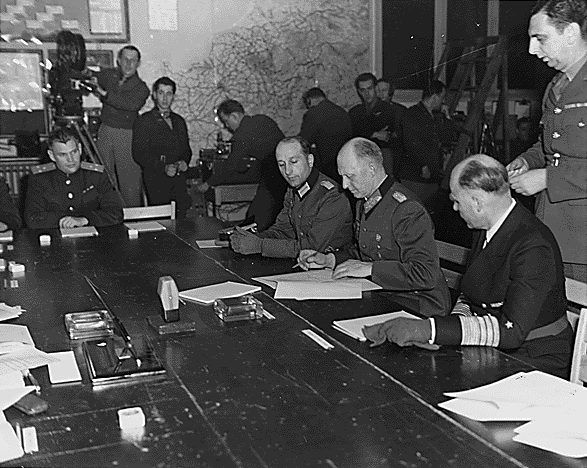
What happened on May 7, 1945, changed the course of history forever. On that day, Germany put its signature on the German Instrument of Surrender — an unconditional capitulation to the Allied Forces that effectively brought World War II to a close. When a nation surrenders unconditionally, it does so without receiving any guarantees about how it will be treated or what lies ahead. The winning side gains full authority to dictate terms and decide the future of the defeated country and its lands. For Germany, this meant not only the end of the war but the complete dismantling of the Third Reich.
Interestingly, the surrender document required two separate signings. German General Alfred Jodl first put pen to paper in Reims, France, on behalf of the Allied Forces. However, the Soviet Union was not satisfied — they felt the initial ceremony failed to adequately recognize Germany's surrender to the Red Army. So, on May 8, 1945, Field Marshal Wilhelm Keitel signed the document a second time in Berlin at the Soviets' insistence.
Terms of the Unconditional Surrender
- Active combat across Europe came to an official end, signaling a decisive Allied victory.
- Beyond ending hostilities, the Unconditional Surrender dissolved the Third Reich, a regime responsible for untold suffering. With its collapse, the Allied powers took on the burden of governing the German people, ushering in a sense of closure and relief for a war-torn nation.
- A dramatic reshuffling of power followed the Unconditional Surrender. Every previously existing pact or treaty was rendered null and void, and the Allied forces bore no obligation to honor any prior agreements — a stark demonstration of their newly established authority.
- Under a "free-hand" policy, the Allied forces received sweeping latitude to administer Germany as they saw fit, including the freedom to redraw territorial boundaries.
- The country was carved into four occupation zones, each controlled by the United States, the Soviet Union, Great Britain, and France. Berlin, though situated within the Soviet-controlled zone, was itself subdivided into four additional zones.