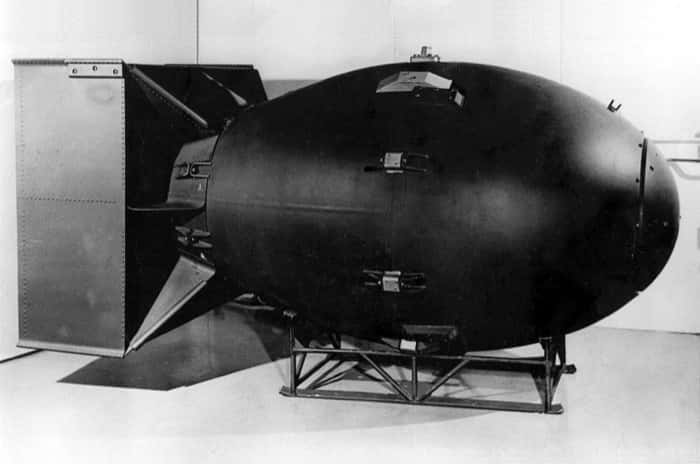
Just three days after the world witnessed the first-ever use of a nuclear weapon in combat, the United States struck again. On August 9th, 1945, an atomic bomb codenamed "The Fat Man" was released over Nagasaki, Japan. This marked the second — and so far last — time a nuclear weapon has been deployed in warfare. The first, dubbed "Little Boy," had devastated Hiroshima on August 6th, 1945. The moniker "Fat Man" was inspired by the weapon's wide, rounded profile, characteristic of its implosion-type design. By 1950, it had been retired from the arsenal.
Facts:
- On the unprecedented dates of August 6th and 9th, 1945, the United States dropped two atomic bombs on the still-populated Japanese cities of Hiroshima and Nagasaki, unleashing destruction on a scale the world had never seen.
- In Hiroshima, the bomb's devastating force tore through the city, taking the lives of roughly 125,000 civilians, 20,000 soldiers, and 12 prisoners of war.
- The toll in Nagasaki proved equally catastrophic — within the first four months alone, approximately 80,000 people died from radiation poisoning, a haunting testament to the lasting consequences of nuclear warfare.
- These bombings had an immediate geopolitical effect: just a month later, on September 2nd, the Japanese government formally signed the instrument of surrender.
- Prior to the attacks, the United States had attempted to warn Japanese civilians about possible air raids by scattering leaflets throughout the country.
- It is believed that these leaflets were intended to heighten the psychological toll of the bombings. That said, no leaflets were actually dropped ahead of the bombs themselves.
- Known by the nickname Fat Man, the second atomic bomb was released at 11.02 am from an altitude of 1650 feet above the city.
- Nagasaki was selected as a target because of its significance as a shipbuilding hub — the vessels constructed there were destined for use in warfare against the United States and other nations.
- The aircraft carrying the bomb was piloted by Frederick Bock. It was a 29-bomber that bore the name Bockscar.